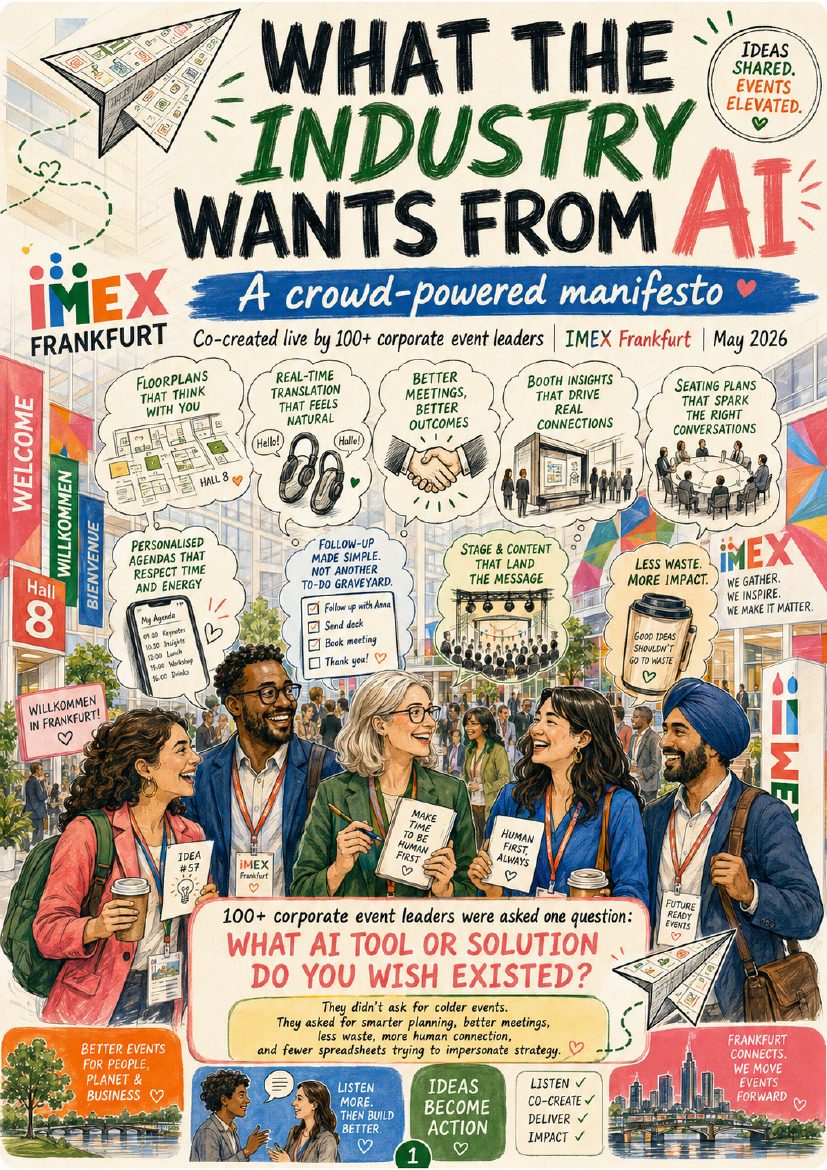
At IMEX Frankfurt – the global marketplace of the meetings and events industry – we asked 100+ corporate event leaders one question: sketch the AI tool or solution you wish existed. No survey, no committee, no consultants. This is what their collective intelligence revealed.
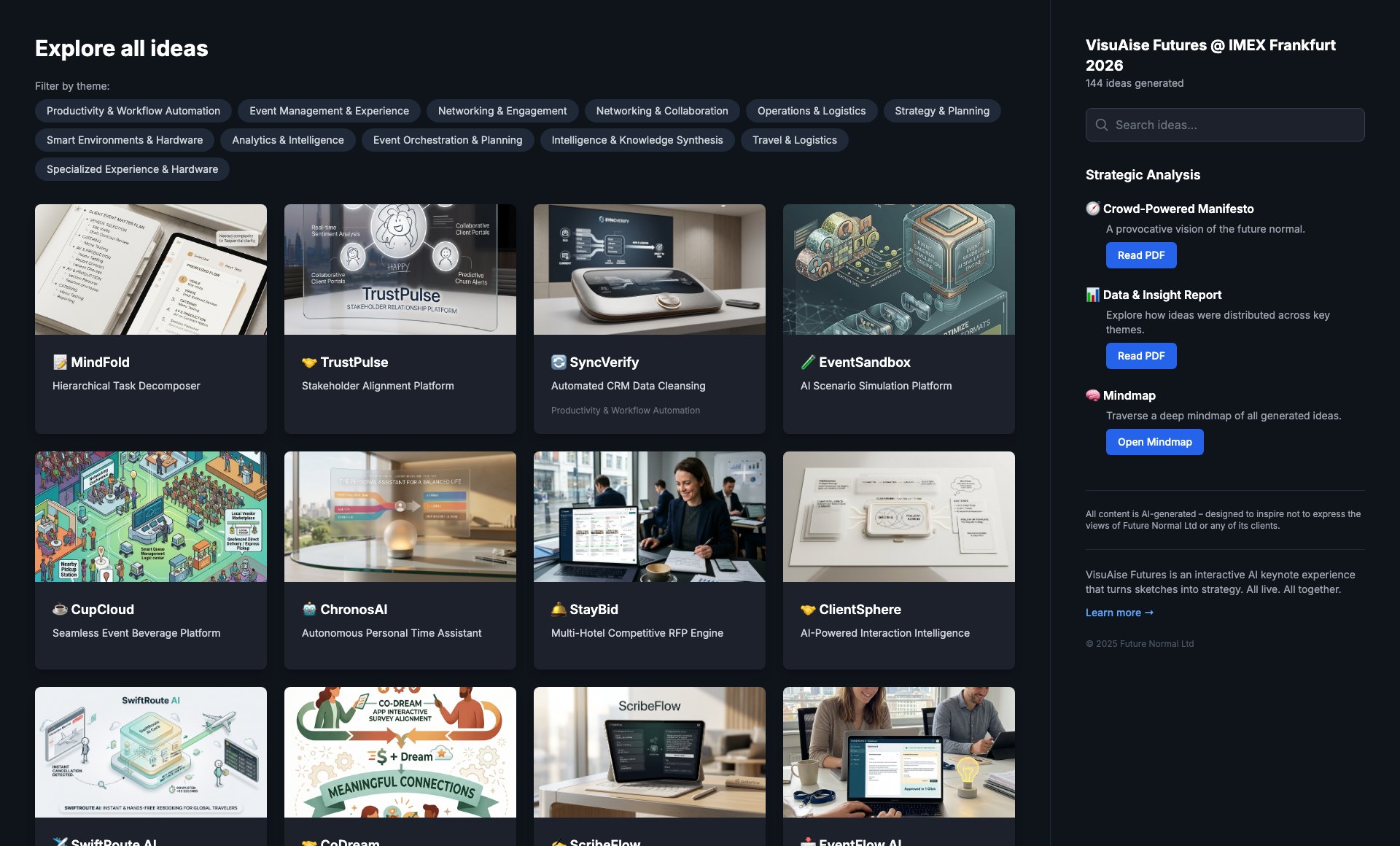
Real, unretouched sketches from the room – tap any one to reveal the AI-generated concept it became.
The single largest cluster – 28.7% of all ideas – wasn't a feature request. It was the collapse of the entire planning pipeline into one orchestration layer. ConceptCore, ConceptFlow, CharterCore, EventRapid, EventEngine, EventSphere, EventBlueprint, VentureFlow, GuestQuest – read together, they aren't nine products. They're the same product, drawn nine different ways. The brief lands, and AI builds the RFPs, models the floor plan, flags the conflicts before they happen. The planner stops being chief logistician – and becomes chief orchestrator.
Every insight on this page is drawn directly from the audience's own submissions – sketched live, transformed by AI, analysed while the room was still buzzing. Theme percentages are quoted verbatim from the published Data & Insight Report.
Read together, the sketches stop being individual wishes and start sounding like a shared declaration – a crowd-powered manifesto for what the industry wants from AI.
The brief lands. AI builds the RFPs, surfaces the three vendors who can actually deliver, models the floor plan and flags the conflicts before they happen. The 200-tab planning spreadsheet retires. The work that used to cost weeks costs a Tuesday afternoon.
From the room: ConceptFlow turns strategy into event design · EventRapid – "quotations in seconds" · EventBlueprint AI plans like a pro, for non-pros
"Director of Strategy" tells you almost nothing. "Trying to ship a circular packaging pilot in Q3" tells you everything. The room sketched matching on ambitions, projects and ways of thinking – not designations. Serendipity stops being lucky. It gets engineered.
From the room: Synapse matches ideas, not job titles · SynchroMesh pairs people by real-time interests · BrewNetwork starts the right conversations over coffee
Event energy used to evaporate in the parking lot. Now every conversation captures itself, every commitment lands in a to-do list before the elevator opens, every business card becomes a follow-up sequence by hotel check-in. The handshake becomes the start of execution, not a polite end to it.
From the room: EchoAction turns talk into tasks · FairRecall rescues the business cards on the train home · SyncSense ranks the day's meetings before anyone has slept on them
Two attendees register for the same conference and walk into different events. AI reads each profile, weights the agenda against their goals, and routes them to the sessions, conversations and booths they actually came for. The conference of one finally arrives.
From the room: EventNexus answers "which session, and who should I meet?" · ShowPath navigates the show floor around your goals · SessionBrief sends everyone home with their own takeaways
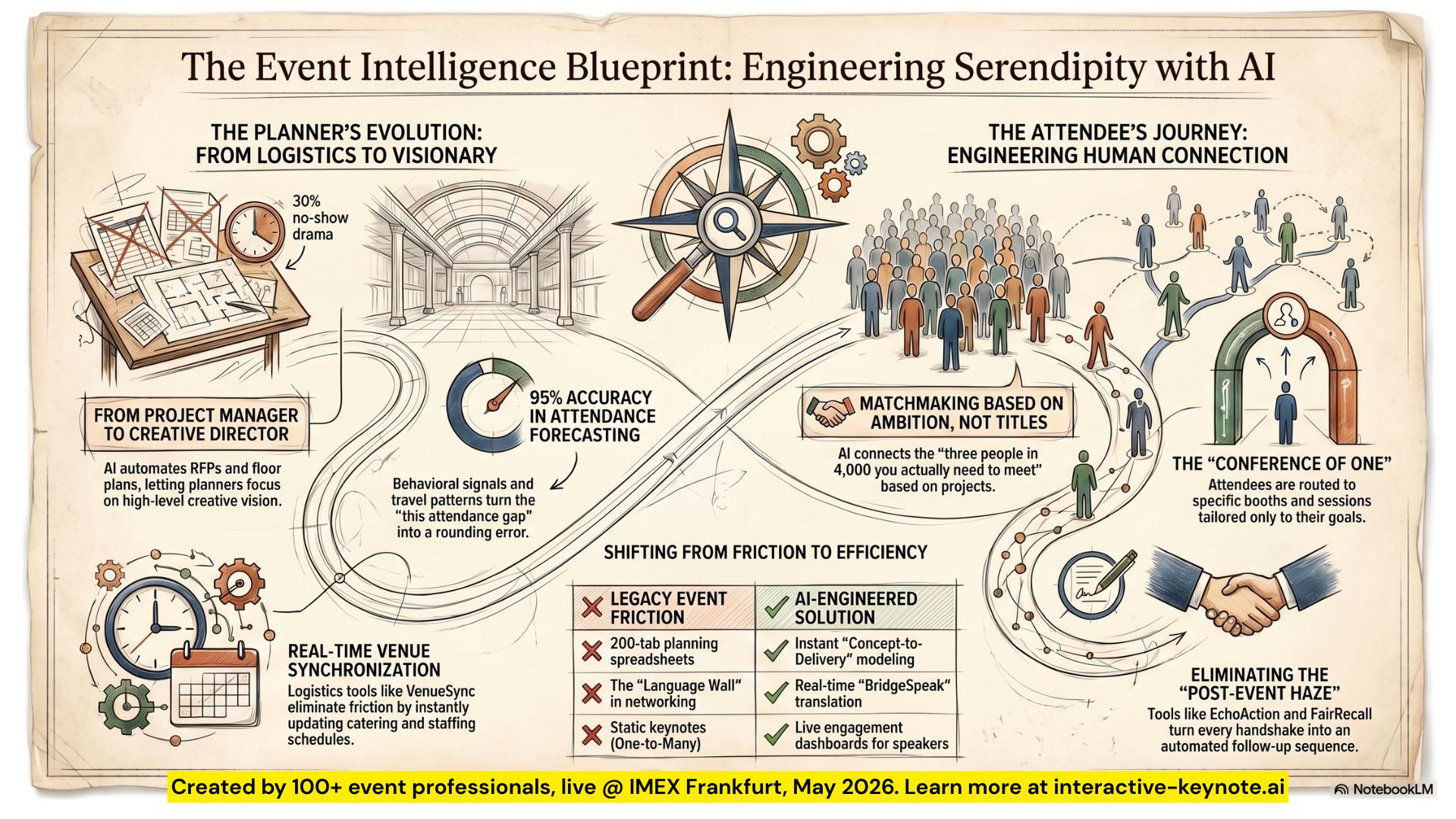
Beyond the consensus, the sketches surfaced some genuinely novel ideas – the kind no industry roundtable would surface.
RSVPulse and AttendSure read the behavioural signals – travel bookings, calendar conflicts, registration patterns – and forecast attendance days out, so catering, badging and seating flex automatically. The 30% no-show drama becomes a budget line you stop writing.
Theme: RSVP & no-show intelligenceVibePulse sketched a private dashboard pulsing with the room's engagement: confusion in row 12, energy in section A, attention drifting at the back. The speaker pivots mid-sentence – from data to story, from talking to asking. Keynotes stop being broadcasts and become conversations.
Theme: live engagement & sentimentSynapseID imagined ambient recognition replacing lanyards entirely; OmniSight layered AR networking intelligence over the room. It's a quiet but real challenge to how trade shows have always worked – and SafePulse, the privacy-first counterweight, was sketched in the same room.
Theme: the post-badge futureThe pharma CMO sees a different story than the procurement lead than the journalist than the student. Sketches like BoothFlow and StrideSync turn the static booth into an adaptive storefront – and exhibitors finally learn which conversations were worth the rental fee.
Theme: the one-of-one exhibitionEvery submission was analysed and clustered live. Here's the full distribution – and what each theme signals.
Total coverage exceeds 100% – most ideas spanned multiple themes, reflecting the integrated, systems-level thinking of participants. Percentages quoted verbatim from the published Data & Insight Report, generated live from the session's first 80 ideas; the portal has since grown to 144.
Because a signal report can be a data table – or it can be an eight-page crowd-powered manifesto in graphic-novel form. Four declarations, three what-ifs, one closing argument. Proof that strategic doesn't have to mean dry.

Flip through all eight pages – or download the full manifesto.
The most strategically valuable signals aren't the consensus – they're the places where 144 ideas pull in opposite directions.
28.7% of the room sketched a unified orchestration layer – "all the info I need for my event in one place." But 16.2% imagined a specialist procurement agent, 15.0% a specialist follow-up agent, 13.8% a specialist live-engagement agent. Which model wins – the all-in-one event ERP, or the modular stack of agents talking to each other? The answer changes who you buy from. And who buys you.
The room asked AI to do what every event has always done – figure out who's here and who they should meet. SynapseID wants to abolish badges entirely; OmniSight wants AR over the room; SynchroMesh wants matching by ambition rather than identity. Only one submission – SafePulse – put anonymisation in the architecture. The design question nobody answered: what does ambient recognition look like when it's not creepy?
One half of the room wants the attendee experience to become more generative – live sentiment heatmaps, adaptive content, one-of-one agendas. The other half wants the operational work to disappear – RFPs in seconds, no-shows forecast, contracts auto-negotiated. Both bets are valid; they sit in different budgets and prove out on different metrics. If you only have one AI investment this year, which side of the curtain do you fund first?
The prompt asked for the tool they wished existed – so these absences are invitations, not oversights. They're exactly where the next advantage hides.
144 ideas about the future of events – and not one put sustainability at its centre. No carbon-budgeting copilot, no waste-forecasting agent, no AI that makes the responsible choice the default. For an industry with loud public net-zero commitments, the silence is the signal.
What if sustainability became the path of least resistance? An AI layer that picks venues by rail access, forecasts catering to the plate, and prices carbon into every RFP draft wouldn't just tick the CSR box – it would hand the first mover the credibility every competitor then has to buy.
The room handed AI the spreadsheet, the inbox, the RFP and the follow-up – yet almost nobody sketched what the freed-up planner becomes. Every idea liberates hours; not one asks what those hours are for. Burnout is this industry's open secret, and it went undrawn.
What if the dividend were designed, not assumed? The first organisation to define what its planners do with the reclaimed week – creative direction, client strategy, actual weekends – doesn't just keep its people. It owns the talent story of the industry.
Nearly 29% of the room is imagining a single orchestration layer that replaces the spreadsheet, the inbox, the Slack channel and the vendor portal. If you're a venue, a DMC or a corporate planning team – what would it cost you to be the platform of record? And what would it cost to be just one of the tools inside someone else's?
Three independent submissions imagined matchmaking by what someone is trying to build, not what their LinkedIn says. If you ran a 200-person event tomorrow with no badges and no titles – just "what are you working on?" – what's the worst that happens? And what's the best?
15% of the room is fixated on the canyon between the handshake and the follow-up email. Audit your last event: of the 200 conversations that happened, how many turned into anything? The gap between that number and the total is the actual ROI of your next AI investment.
Every idea has its own page – concept images, AI roast, shareable idea card, and a full Deep Innovation report assessing feasibility and a draft launch plan.
Answer three quick questions and we'll point you to the ideas in the dataset most worth your attention – quite possibly including your own.
Download a single consolidated .md file and drop it into your LLM of choice, ready to query for insights related to your current projects.
Unfiltered, opt-in feedback captured live at IMEX Frankfurt – 115 responses, 99% rated the session valuable.
Like a really intelligent conversation disguised as a session. Sharp insights, zero unnecessary jargon – the kind of ideas that continue in your head long after the room empties.
Captivating, immersive and engaging. Thank you!
I always thought AI just helps us do things faster – but actually it is a completely new world.
I have heard a lot on AI before, but this session with live demos was a great experience.
I learned about the power of AI to help solve day-to-day challenges in the world of events.
Informative and motivating – I even want to try to build something on my own.
A lively talk – keeping and holding my interest through the entire presentation.
A great change of view on AI – very engaging and inspiring.
Super insightful and valuable info to take away.
Like a really intelligent conversation disguised as a session. Sharp insights, zero unnecessary jargon – the kind of ideas that continue in your head long after the room empties.
Captivating, immersive and engaging. Thank you!
I always thought AI just helps us do things faster – but actually it is a completely new world.
I have heard a lot on AI before, but this session with live demos was a great experience.
I learned about the power of AI to help solve day-to-day challenges in the world of events.
Informative and motivating – I even want to try to build something on my own.
A lively talk – keeping and holding my interest through the entire presentation.
A great change of view on AI – very engaging and inspiring.
Super insightful and valuable info to take away.
No app. No survey. No consultants. Just pens, paper, a QR code – and an audience doing what no live poll has ever managed: thinking out loud, together.
Everyone sketches their idea. Pen and paper. No artistic skill required.
Scan a QR code, photograph the sketch. No app, no login.
AI turns every sketch into polished concepts – shown live on the big screen.
Themes, tensions and insights emerge from the collective input – in minutes.
You've just experienced the transformational power of AI-native thinking and doing. Strategy engagements used to take months to assemble these insights, but the audience produced the raw material live, mid-keynote – and the analysis you're scrolling was in their hands while the room was still buzzing.
VisuAIse Futures shows 10x thinking in action: the keynote stops being a broadcast and becomes a shared experience. Your audience stops being spectators and becomes your strategy team. And because they co-created every artefact on this page, they want to engage with it afterwards – psychologists call it the IKEA effect; event organisers call it post-event content people finally open.

Every industry has a future its people can already see – they've just never been asked to sketch it. If you're planning a conference keynote, leadership offsite or customer event, let's turn your next audience into your strategy team.
Or just email renee@ideapress-speakers.com