In Henry Coutinho-Mason's keynote at Lyreco's Future of Work event in Brussels, we handed a room of 150+ leaders a blank page and one provocation: which AI tool or solution would you love to deploy in your business in 2027? Sketch it. No survey, no committee, no consultants. This is what their collective intelligence revealed.
Most "AI at work" conversations open with efficiency. This one opened with growth. The two largest clusters – Anticipatory Customer Service (28%) and Autonomous Sales Growth (24%) – together touch more than half the ideas in the room, and both point outward. These leaders don't want a cheaper back office first; they want the order on the truck before the customer calls, and the rep to only ever meet a buyer who's ready. The room aimed AI at the top line, not just the cost line.
Every insight on this page is drawn directly from the audience's own submissions – sketched live, transformed by AI, analysed while the room was still buzzing. Theme percentages are quoted from the published Data & Insight Report.
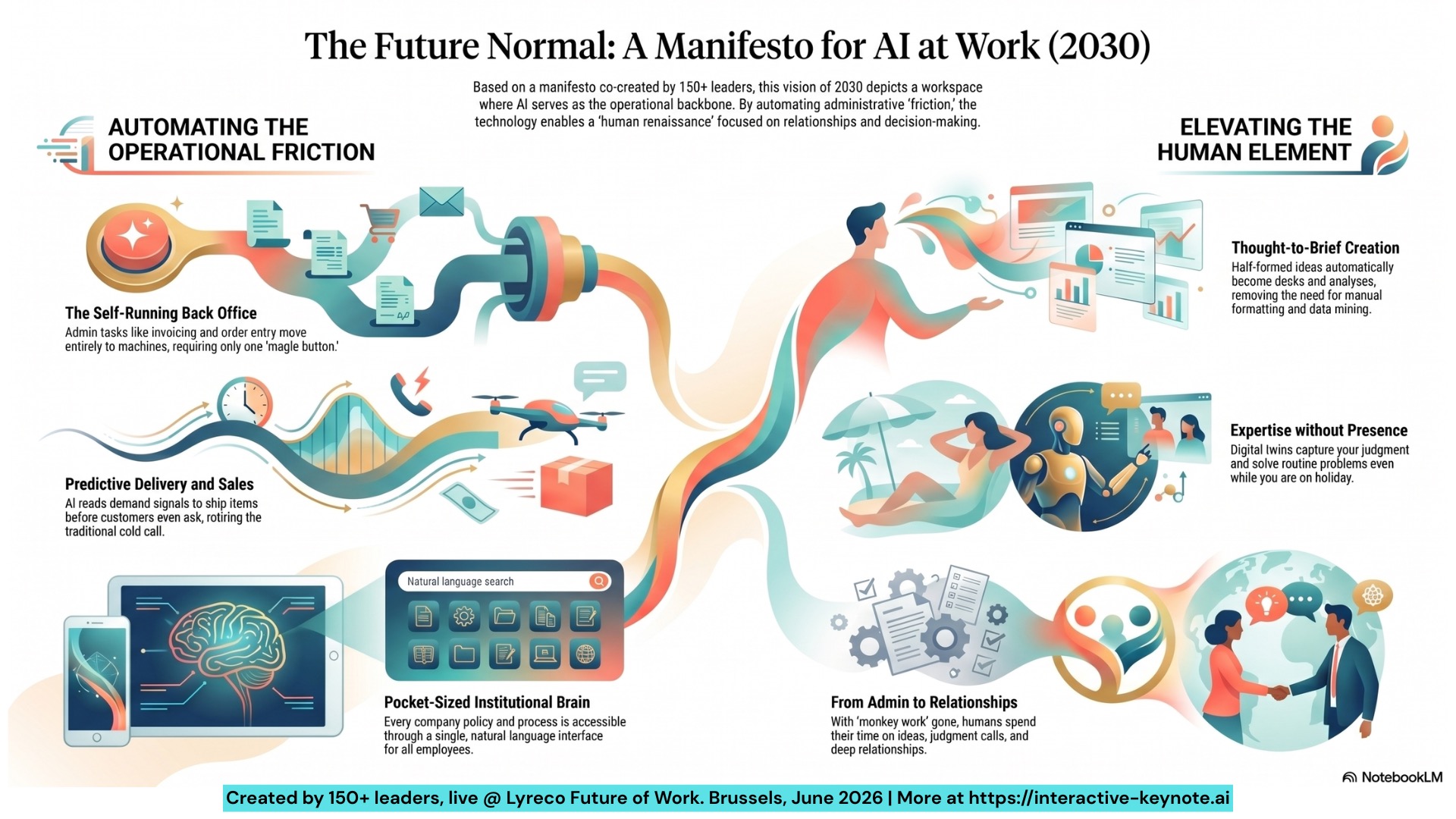
Read together, the sketches stop being individual wishes and start sounding like a shared declaration – a crowd-powered manifesto for what work wants from AI.
The reconciliation, the order entry, the BAR file, the invoice nobody wanted to sort – all of it moves to the machine, intermediaries and all. One magic button clears the admin. What's left is the work a person actually signed up for: the idea, the relationship, the judgment call.
From the room: MagicAdmin – one-click business operations · OptiStream – resilient value delivery · DriveFlow AI – parallel task execution
AI reads the signals – what they bought, what they're running low on, what the season demands – and the right items are on the truck before anyone picks up the phone. The cold call retires. Reps stop chasing ghosts and only ever meet customers who are ready to buy.
From the room: TopLine Factory – autonomous B2B revenue engine · OfferStream – predictive personalisation · AffiliVoice – a 24/7 affiliate desk
Every policy, product sheet, process and half-buried email folds into one brain that answers in plain words, in your language, on demand. No more hunting three departments for one answer. On day one, the new hire knows what the twenty-year veteran knows.
From the room: ItemLogic – unified product intelligence · DocuGlobe AI – localised product docs · LingoBridge – real-time translation · PulseQuery – an HR brain you can ask
The half-formed idea in your head becomes the brief, the analysis, the deck – without the three nights of formatting. The mountain of data you couldn't read hands you the opportunity buried inside it. Meetings stop ending in "someone write this up."
From the room: ClarifyAI – idea-to-brief generator · ThinkChill – automated task clarification · ScribeSync – the pen that files itself
Beyond the consensus, the sketches surfaced genuinely novel ideas – the kind no industry roundtable would ever produce.
A cluster of leaders sketched a twin of themselves – capture how you think, how you sell, how you solve, onto a chip. MyAgent gives every employee a personalised copilot; FounderProxy keeps a founder's judgment on tap across continents. The routine calls get answered in your voice while you're on a beach. Being irreplaceable stops meaning being unable to leave.
Theme: the digital twinAn invoice lands. SpendVigil checks it against your live budget and the actual ledger; ProcureDraft turns the contract into a conversation. The system files it, analyses it, and tells you in plain words: safe to approve, or not. The month-end surprise disappears. Procurement stops being paperwork and becomes a conversation that ends in "yes".
Theme: procurement & spend intelligenceFeandy qualifies the room before anyone walks in; TopLine Factory filters the time-wasters out of both sides of the table. Your reps only meet customers who are ready; your customers only meet the suppliers they actually need. The pitch disappears. What's left is two people who already want to do business – sales, quite literally, falling from the sky.
Theme: autonomous sales growthHanded a blank page and asked about work, roughly one in ten left the office entirely – a garden designer (BioGarden), a digestive-health monitor (GutInsight), a coach, a tutor, the best route home on the bike. It looks like distraction. It's a signal: the people who'll adopt AI fastest at work are the ones already inviting it into the rest of their lives.
Theme: AI for life, not just workEvery submission was analysed and clustered live, each idea tagged against every theme it genuinely spans. Here's the distribution – and what each theme signals.
Percentages quoted from the published Data & Insight Report (139 ideas, each tagged against every theme it genuinely spans). Total coverage exceeds 100% because most ideas span multiple themes, reflecting the integrated, systems-level thinking of participants. A handful of ideas sat outside every cluster – around one in ten left the workplace altogether (see the white space).
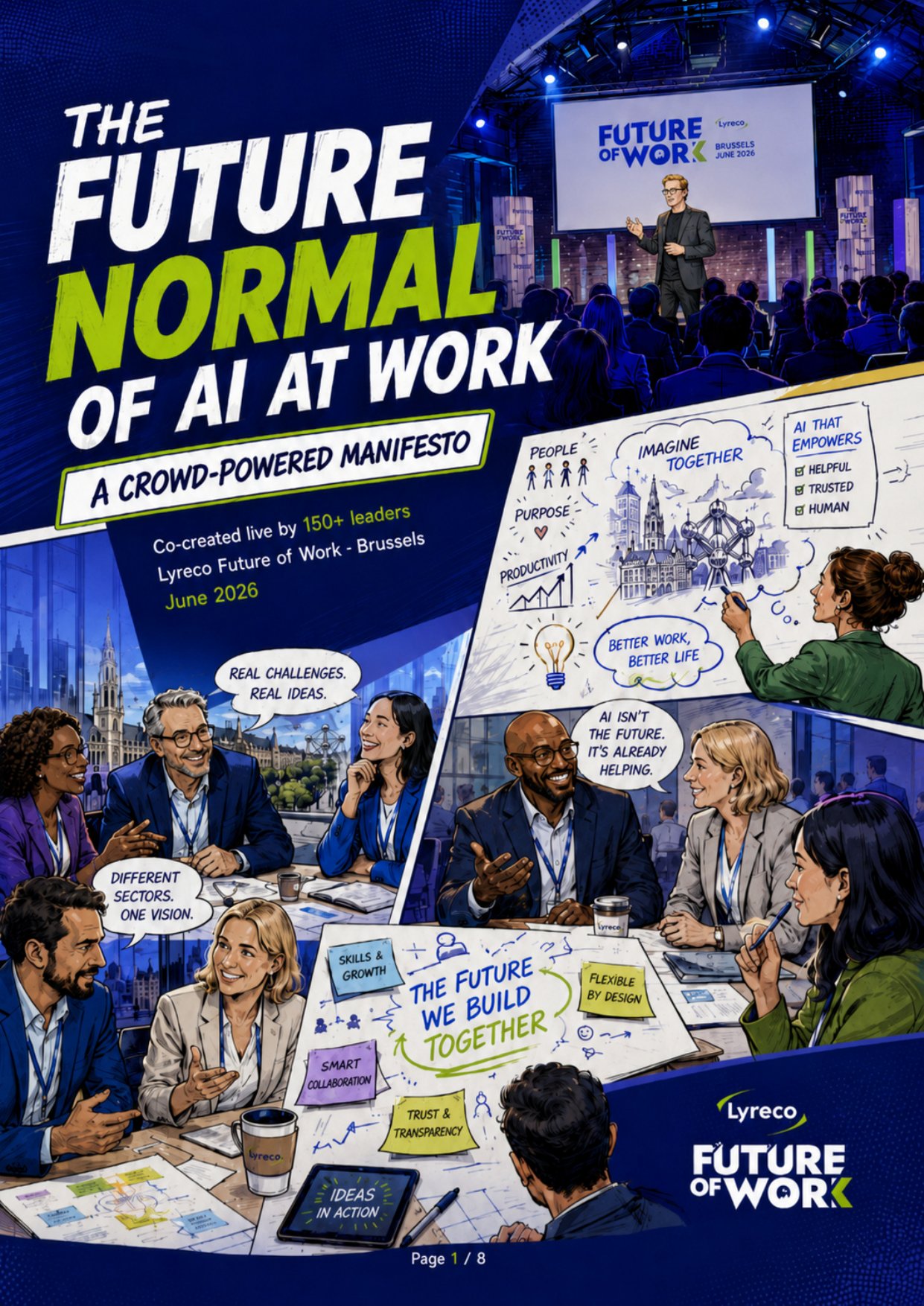
Because a signal report can be a data table – or it can be an eight-page crowd-powered manifesto in graphic-novel form. The room's declarations, redrawn. Proof that strategic doesn't have to mean dry.

Flip through all eight pages – or download the full manifesto in comic form.
The most strategically valuable signals aren't the consensus – they're the places where 139 ideas pull in opposite directions.
The same people who want the back office fully self-running are the ones who fought hardest to protect "creative human interaction" and "genuine connections with our consumers". The fight isn't whether to automate, but where to stop. Resolution lives at the boundary of empathy and judgment – name it before the tooling decides for you.
Predicting the order before it's placed, a single view of the customer, defining needs in advance – all of it demands deep data on the customer. The more the business knows, the better the anticipation, and the closer it edges to creepy. The unlock is anticipation that feels like service, not surveillance – consent that reads as care.
Most ideas carefully said the kind part: automate the task, free the person. A few said the quiet part out loud – "eliminate some people and processes". The same tool that frees a colleague can remove them. The real decision isn't technical, it's a leadership choice – redeploy or reduce – and this room is genuinely split on it.
The provocation asked for the AI they wished existed – so these absences are invitations, not oversights. They're exactly where the next advantage hides.
The appetite to hand drudgery to the machine was everywhere. But the workforce coming with it barely appeared: Autonomous HR & Hiring (5%) and Freeing People for Human Work (8%) were the smallest clusters in the room. The tools were drawn in vivid detail; the humans learning to ride them were mostly assumed.
What if AI-fluency were the headline programme, not the afterthought? The organisation that makes its people fluent fastest gets the compounding return – every tool lands softer, sticks harder and pays back sooner.
Asked point-blank for a work tool, roughly one in ten drew something for life: a fitness coach, a classroom tutor, a health scan off your phone, the best route home on the bike. It's easy to file as off-brief. It's actually a tell – these are the people most ready to live alongside AI, showing you exactly where delight lives.
What if the "unreasonable" ideas got their own horizon-two track? The reflex that reached past the job is the same reflex that will adopt fastest inside it. Give it somewhere to go instead of discarding it.
For the leaders and the innovation, L&D and commercial teams who'll carry them.
The room's energy is on growth, so begin where AI wins or keeps a customer – an anticipatory reorder, ready-to-buy routing, a 24/7 affiliate desk – not just where it shaves a euro. Pick one journey and build it end to end.
Decide explicitly which tasks move to the machine (admin, reconciliation, order entry, intake, contract review) and which stay human (the relationship, the judgment, the creative call). Make it a stated principle – and be honest with the room about redeploy vs. reduce.
The most repeated frustration was the simplest: people can't find what the company already knows, in the language they work in. One self-serve, multilingual knowledge layer pays back across every team. Start with the questions clogging email today.
"Clone the expert", the pocket expert, the twin that works while you're on holiday – buildable now. Capture one top performer's playbook into an assistant that fields the routine and travels with the team. Begin where the bottleneck is most expensive.
The bike routes, the fitness coaches, the classroom tools aren't clutter – they're the people most ready to adopt, showing you where delight lives. Give the most "unreasonable", human ideas a separate horizon-two track rather than discarding them.
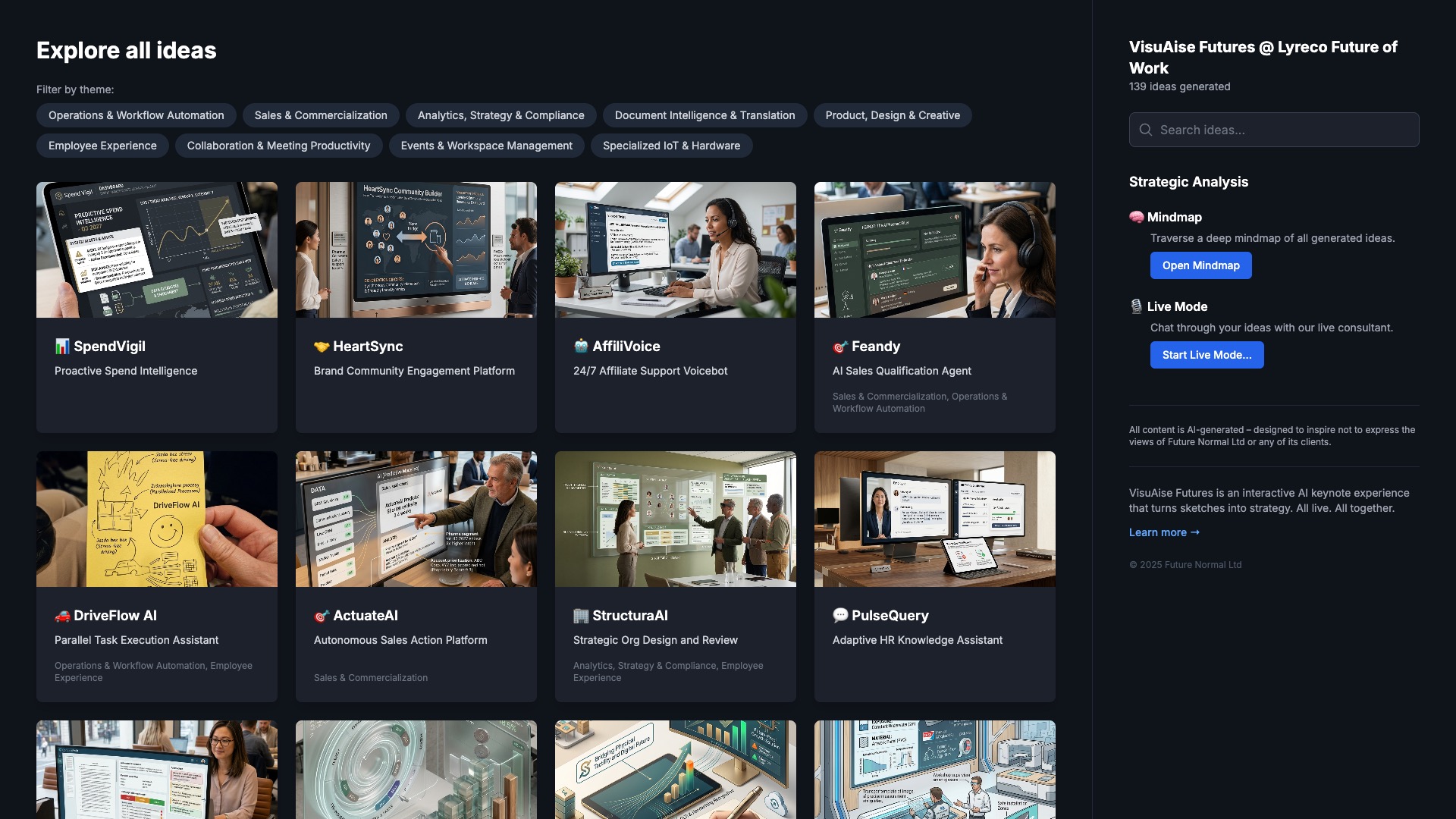
Every idea has its own page – AI concept images, an AI roast, a shareable idea card, and a full Deep Innovation report assessing feasibility with a draft launch plan.
Download a single consolidated .md file – all 139 ideas plus their full Deep Innovation reports – and drop it into your LLM of choice, ready to query against your current projects.
Not sure where to start with 139 ideas? Answer three quick questions and we'll point you to the three from the room most worth your attention – quite possibly including your own.
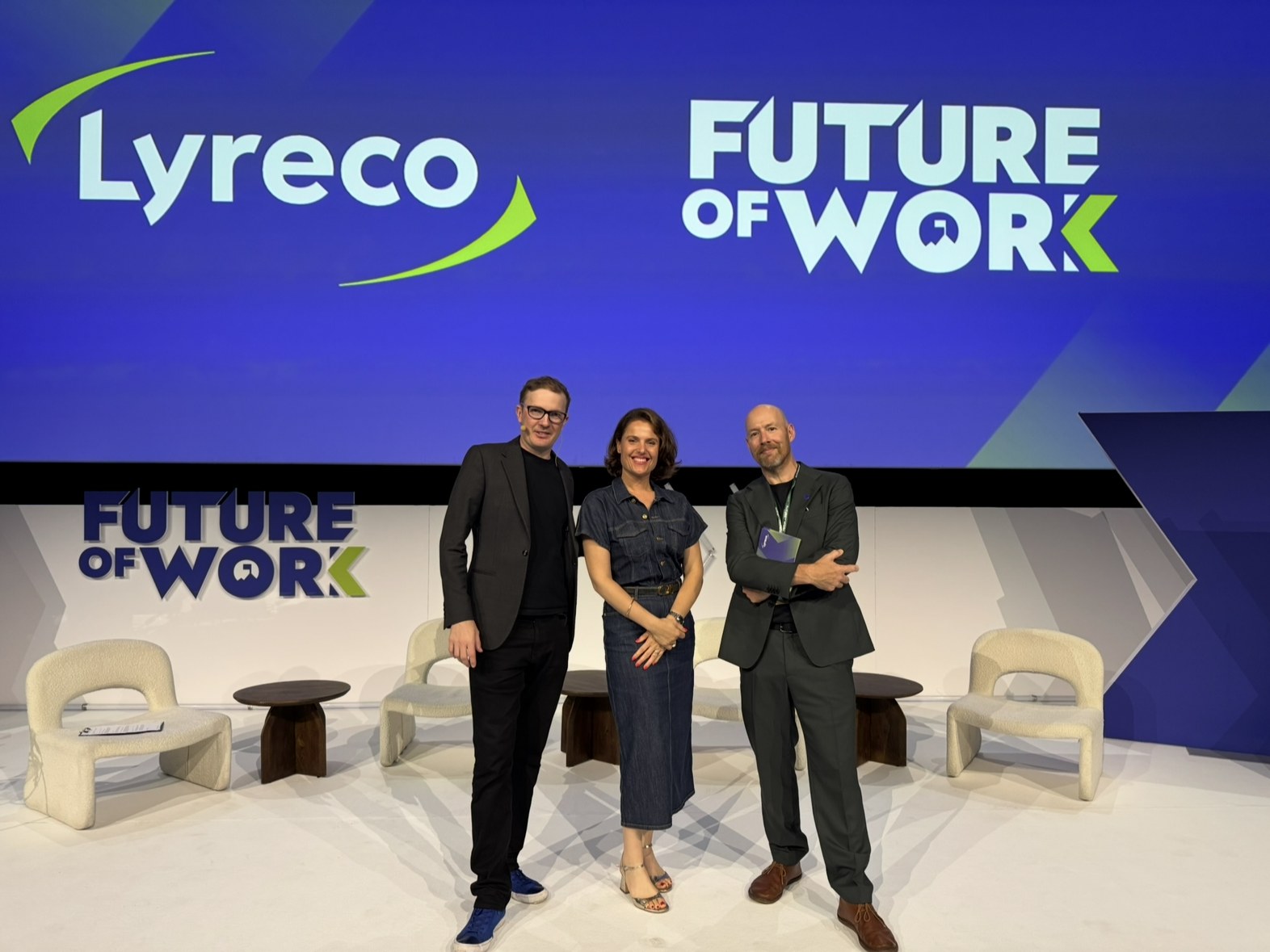
Henry's full Lyreco Future of Work presentation – The Future Normal: Designing a People-First AI Strategy – yours to download and revisit.
No app. No survey. No consultants. Just pens, paper, a QR code – and an audience doing what no live poll has ever managed: thinking out loud, together.
Everyone sketches their idea. Pen and paper. No artistic skill required.
Scan a QR code, photograph the sketch. No app, no login.
AI turns every sketch into polished concepts – shown live on the big screen.
Themes, tensions and insights emerge from the collective input – in minutes.
You've just experienced the transformational power of AI-native thinking and doing. Strategy engagements used to take months to assemble these insights, but the audience produced the raw material live, mid-keynote – and the analysis you're scrolling was in their hands while the room was still buzzing.
VisuAIse Futures shows 10x thinking in action: the keynote stops being a broadcast and becomes a shared experience. Your audience stops being spectators and becomes your strategy team. And because they co-created every artefact on this page, they want to engage with it afterwards – psychologists call it the IKEA effect; event organisers call it post-event content people finally open.

Every industry has a future its people can already see – they've just never been asked to sketch it. If you're planning a conference keynote, leadership offsite or customer event, let's turn your next audience into your strategy team.
Or just email renee@ideapress-speakers.com