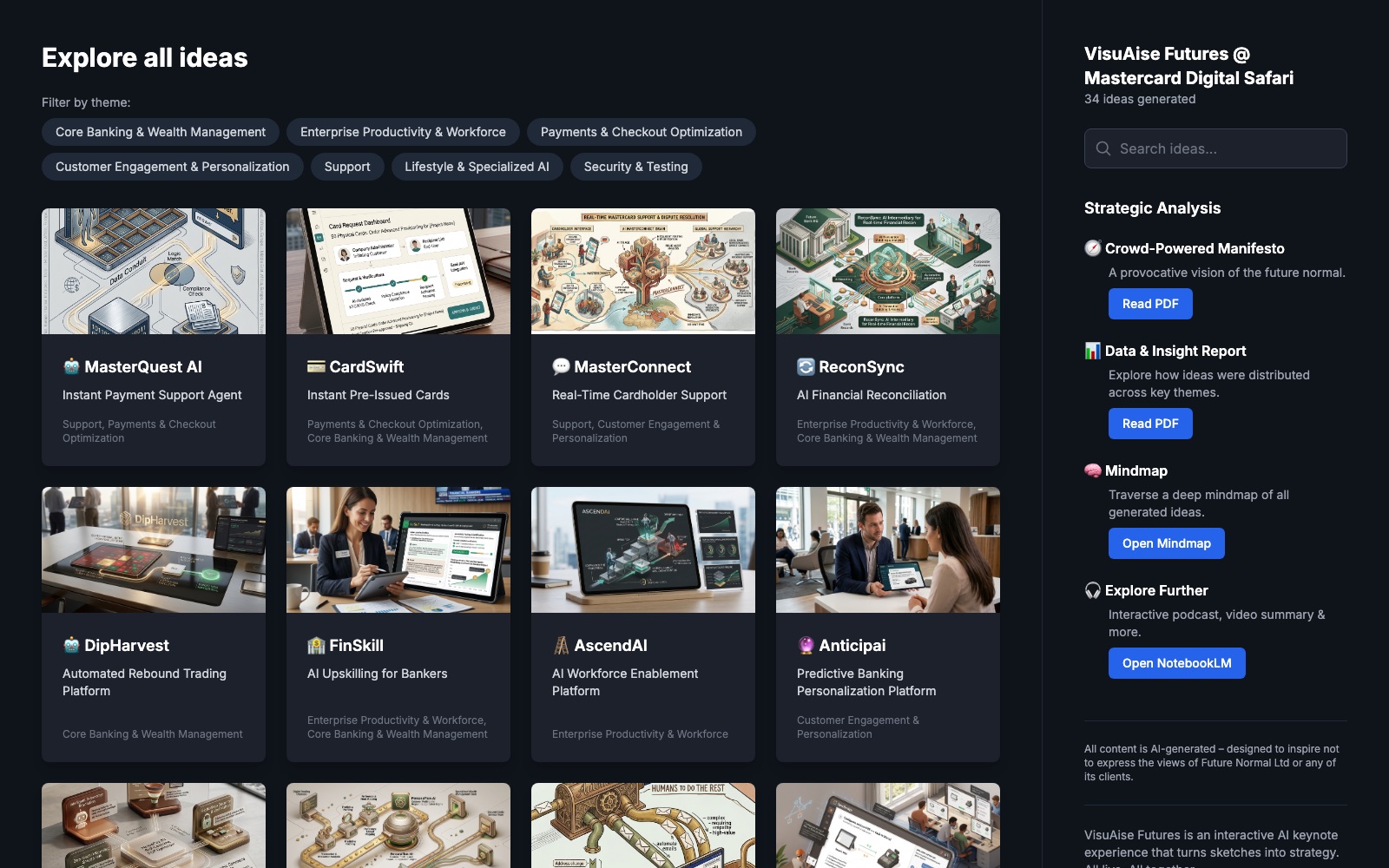
At Mastercard's Digital Safari in London, we handed a room of 30+ finance leaders a blank page and one provocation: imagine an AI tool you'd love to summon into existence – then sketch it. No survey, no committee, no consultants. This is what their collective intelligence revealed.
Hand 30+ finance leaders a blank page and the biggest pattern isn't a flashy customer product – it's the institution turning AI on itself. The two largest clusters – the Self-Driving Back Office (21%) and Digital Twins for internal noise (18%) – both aim inward, before a single customer is touched. Then the bank learns a new verb: anticipate – moving first instead of waiting to be asked. And where the room got most emotional, it reached to widen the gates: a private banker for everyone. The room didn't draw the robot banker. It drew the back office disappearing – so the banker could go back to banking.
Every insight on this page is drawn directly from the audience's own submissions – sketched live, transformed by AI, analysed while the room was still buzzing. Theme percentages are quoted from the published Data & Insight Report.
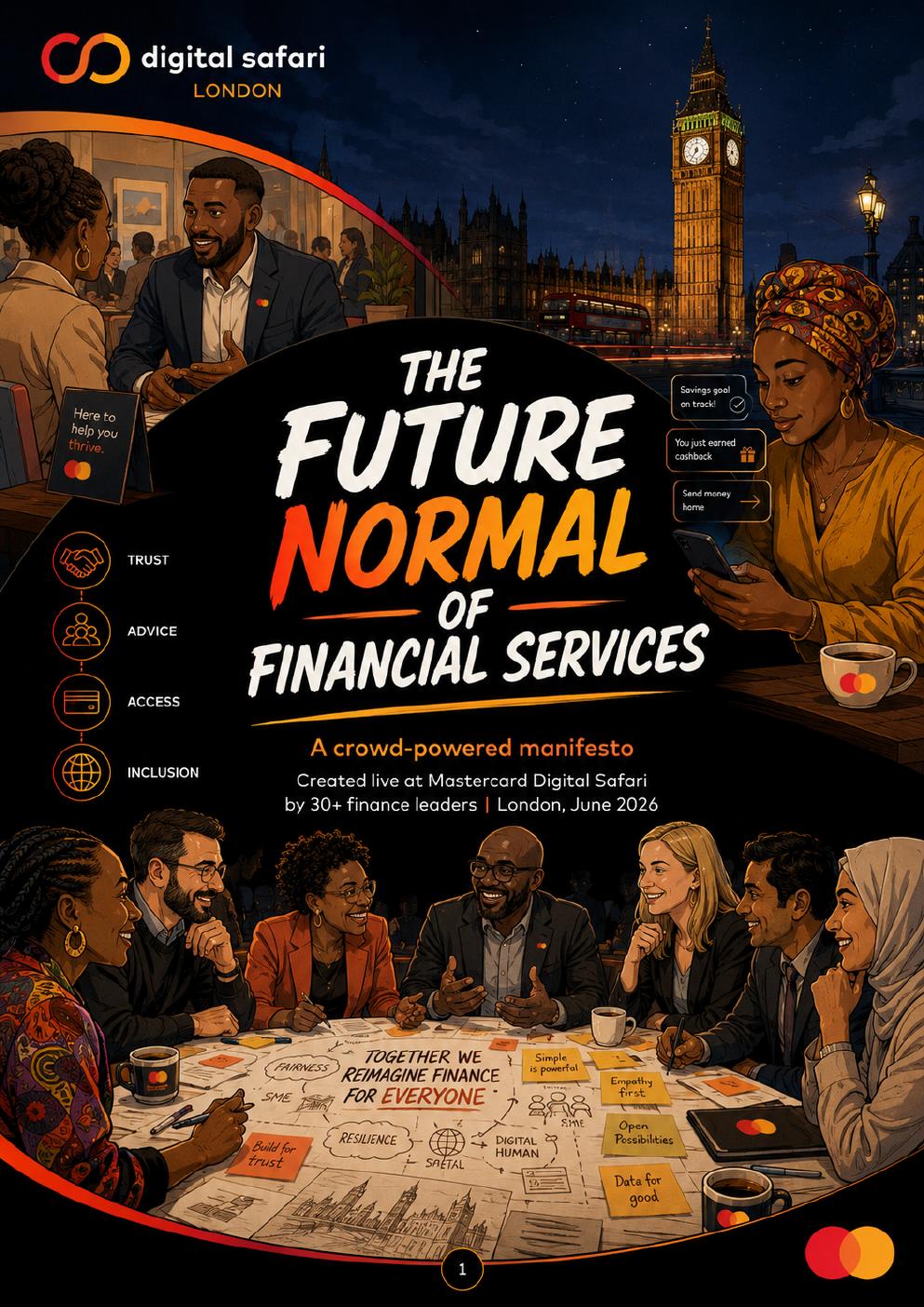
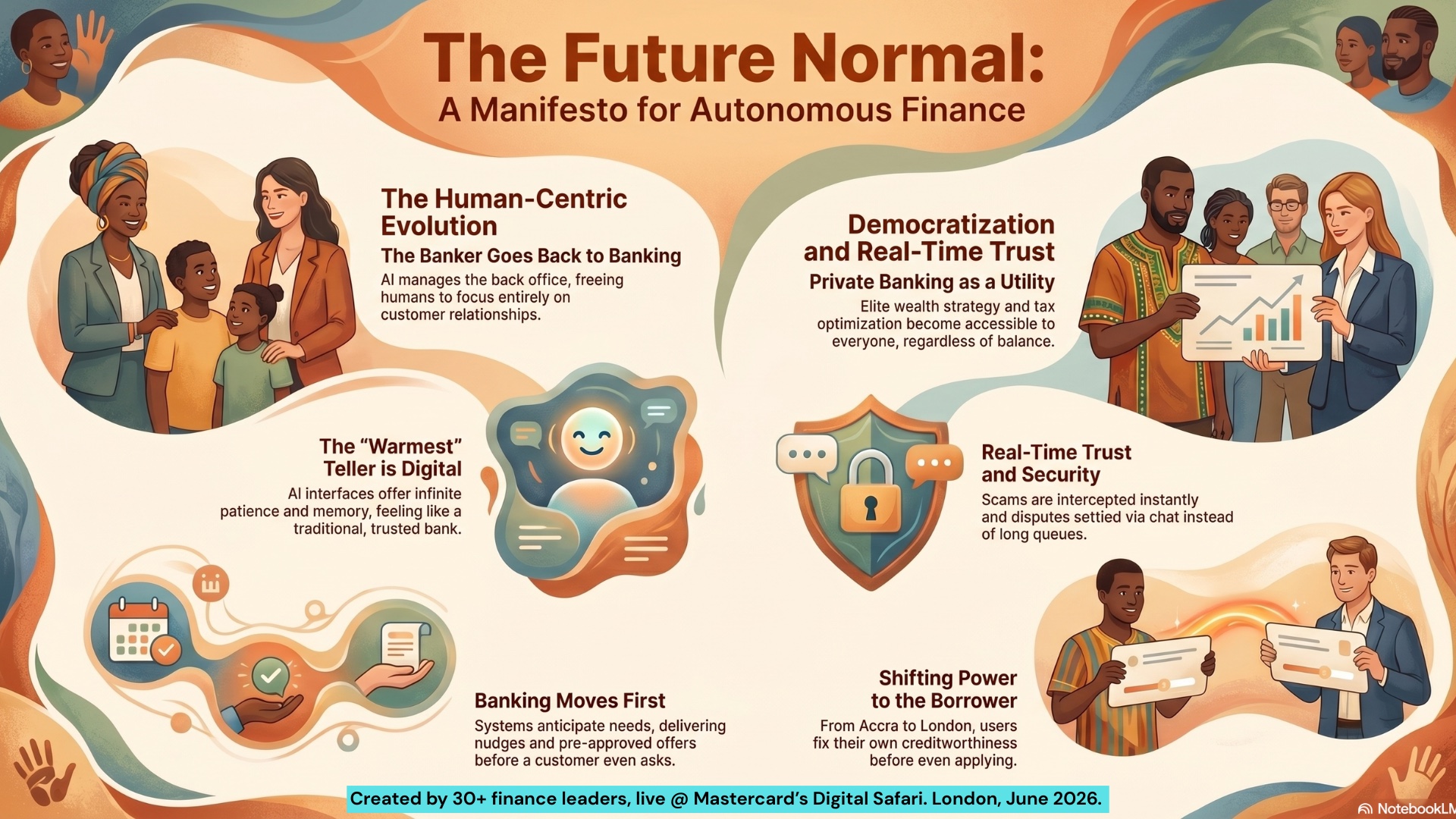
Read together, the sketches stop being individual wishes and start sounding like a shared declaration – a crowd-powered manifesto for what finance wants from AI.
Reconciliation that swallowed weeks now clears in minutes. The shared inbox answers its own routine mail. A digital twin fields the status pings and guards the calendar – freeing the human for the one thing no model can do: sit across from a customer and grow the relationship.
From the room: PersonaAI – your digital twin for internal noise · ReconSync – reconciliation in minutes, not weeks · InboxSynergy – the inbox that answers itself
Your salary lands. A flight gets booked. The subscriptions quietly creep up – and the nudge, the advice, the pre-approved offer arrives before you go looking. The application form retires. Banking turns from a place you visit into a service that reads the moment and moves first.
From the room: Anticipai – anticipate the need, send the offer · NudgeFlow – transaction signals become timely nudges
The wealth strategy, the tax optimisation, the endlessly patient teller – all once roped off for the rich. Now it answers anyone, in any language, whether they hold fifty pounds or fifty million. The velvet rope comes down. Advice becomes a utility, not a privilege.
From the room: EquiWealth – a private banker for everyone · ClassicTeller – infinite patience for older customers · SikaScore – credit visibility in Ghana · TreasuryScale – multinational-grade treasury for SMEs
The scam is intercepted before it reaches the people who'd fall for it. The disputed charge is settled in a chat, not a six-week queue. Risk is read live, in the moment of the transaction – not reconstructed afterwards in the post-mortem. Security stops chasing the fraud and starts arriving first.
From the room: ScamSentry – scams intercepted in real time · MasterConnect – disputes settled in a chat, not a queue
Beyond the consensus, the sketches surfaced genuinely novel ideas – the kind no industry roundtable would ever produce.
A cluster of leaders sketched AI that maps not who sits where, but who actually talks to whom – the hidden web of favours, side-channels and quiet experts that really runs the place. NodeAlign surfaces the informal network; SynapseOrg points you straight to the right person for what you need. Bottlenecks get named, and attention stops leaking.
Theme: digital twins & internal noiseCredoLoop runs its own experiments, ships its own layouts and tunes itself to every user by morning. The only thing between full automation and chaos is a set of guardrails it is never allowed to cross. Compliance stops being the brake – it becomes the code.
Theme: autonomous, within the rulesClassicTeller offers infinite patience and all the time in the world. It remembers your name, walks you through every step, and never once makes you feel slow. It feels exactly like the bank you grew up with – and behind the glass, it's running fully automated. Efficiency aimed at dignity, not just cost.
Theme: democratised, dignified serviceIn Accra, a first-time borrower reads their own mobile-money history through SikaScore, sees what's holding them back, and fixes it before they apply. They walk in already knowing the answer. The power to judge creditworthiness shifts from the bank to the person seeking the loan.
Theme: power to the borrowerEvery submission was analysed and clustered live, each idea tagged against every theme it genuinely spans. Here's the distribution – and what each theme signals.
Percentages quoted from the published Data & Insight Report (34 ideas, each tagged against every theme it genuinely spans). Total coverage exceeds 100% because most ideas span multiple themes, reflecting the integrated, systems-level thinking of participants. Four ideas left finance altogether – two wardrobe stylists, a triathlon dashboard and a pet-food reorder bot – and sat outside every cluster (see the white space).
The most strategically valuable signals aren't the consensus – they're the places where 34 ideas pull in opposite directions.
The room wants decisions in seconds – instant credit, real-time disputes, automated onboarding – yet finance runs on the very checks that take time: underwriting, KYC, compliance. Push too hard on speed and "frictionless" quietly becomes "unchecked". The design challenge is to make the controls invisible, not absent.
One idea wants automation "fully end to end… with no human in the loop" (CredoLoop); another insists the machine handle the routine "while humans do the rest" (InboxSynergy). The same room both craves and fears full autonomy. The fight isn't whether to automate – it's where to stop. Resolution lives at the boundary of judgment and empathy.
Nudges, pre-emptive offers and a single view of the customer all demand deep data. The more the bank knows, the better the offer – and the closer it edges to surveillance. The unlock is consent that feels like care, not capture. Whoever gets that feeling right gets the data – and the decade.
The provocation asked for the future they wished existed – so these absences are invitations, not oversights. They're exactly where the next advantage hides.
Handed a blank page, a meaningful slice didn't draw a bank at all: a wardrobe stylist, a triathlon dashboard, a pet-food reorder bot. It looks like play. It's actually a tell – these leaders reached, by reflex, for effortless consumer anticipation – the exact experience they live every day from Amazon, Spotify and their phone.
What if your customers already hold the bank to that bar? The reflex the room showed is the standard its own customers now expect by default. The institution that makes banking feel as effortless as the apps they reached for wins the decade.
The room drew anticipation everywhere – nudges, pre-approved offers, auto-orders, a single view of the customer. What barely appeared anywhere in 34 ideas: consent, the opt-out, the moment to pause. Speed and personalisation both run on deep data, and the line to surveillance is one nudge away.
What if "ask first" were the headline feature, not the friction? The lender that makes consent feel like care earns the trust – and the data – every competitor then has to buy.
For the finance leaders and the innovation and L&D teams who'll carry them.
The room's own ranking says start where risk is lowest and hours saved are biggest – reconciliation, onboarding, internal request-handling. Pick one workflow, measure the time it returns, and use that proof to fund the customer-facing bets.
The "digital twin" wish is buildable now. Capture your best people's playbooks into an assistant that fields the routine and frees them for the complex. Begin with the one role where the bottleneck is most expensive.
Reframe the roadmap around moving first – pre-approved offers, life-event nudges, disputes resolved before they escalate. Audit one customer journey, find the moment you make people ask, and delete it.
The ideas with the most emotional charge – a teller for the elderly, credit visibility in Ghana, treasury for SMEs – are underserved markets in disguise. Pick one excluded segment and build its "private banker for everyone".
Pair every "instant" ambition with the invisible-controls work that earns trust – embedded risk, real-time validation, consent baked in. "Autonomous, within rules it can't break" is the line that lets risk and innovation both say yes.
Every idea has its own page – AI concept images, an AI roast, a shareable idea card, and a full Deep Innovation report assessing feasibility with a draft launch plan.
Download a single consolidated .md file – all 34 ideas plus their full Deep Innovation reports – and drop it into your LLM of choice, ready to query against your current projects.
The complete Data & Insight Report – theme distribution, the four signals, the tensions, and five moves to turn the doodles into a roadmap.
Henry's full Mastercard Digital Safari presentation – The Future Normal: Designing a People-First AI Strategy – yours to download and revisit.
Because a signal report can be a data table – or it can be a seven-page crowd-powered manifesto in graphic-novel form. Four declarations, four what-ifs, one closing argument. Proof that strategic doesn't have to mean dry.

Flip through all seven pages – or download the full manifesto in comic form.
Unfiltered, opt-in feedback captured live at the Digital Safari – 16 responses, 100% rated the session valuable, and 100% said they'd do it again.
No app. No survey. No consultants. Just pens, paper, a QR code – and an audience doing what no live poll has ever managed: thinking out loud, together.
Everyone sketches their idea. Pen and paper. No artistic skill required.
Scan a QR code, photograph the sketch. No app, no login.
AI turns every sketch into polished concepts – shown live on the big screen.
Themes, tensions and insights emerge from the collective input – in minutes.
You've just experienced the transformational power of AI-native thinking and doing. Strategy engagements used to take months to assemble these insights, but the audience produced the raw material live, mid-keynote – and the analysis you're scrolling was in their hands while the room was still buzzing.
VisuAIse Futures shows 10x thinking in action: the keynote stops being a broadcast and becomes a shared experience. Your audience stops being spectators and becomes your strategy team. And because they co-created every artefact on this page, they want to engage with it afterwards – psychologists call it the IKEA effect; event organisers call it post-event content people finally open.

Every industry has a future its people can already see – they've just never been asked to sketch it. If you're planning a conference keynote, leadership offsite or customer event, let's turn your next audience into your strategy team.
Or just email renee@ideapress-speakers.com