Return to main pageBack Bring this to your event
A VISUALISE FUTURES SIGNAL REPORT

The Future Normal of Melbourne's experience economy – drawn by the people who'll build it.

MELBOURNE EXPERIENCE SUMMIT · VICTORIA TOURISM INDUSTRY COUNCIL · JUNE 2026

At the Melbourne Experience Summit, we handed 100+ of Victoria's experience pioneers pens and paper – and asked the same room two questions. First, the warm-up: sketch an experience that will get people off the couch in 2030. Then, the real test: imagine an experience that could only happen in Melbourne. This is what their collective intelligence revealed.

0ideas captured
0+experience pioneers
0questions asked
0minutes, end to end
From Pen and Paper to Strategic Insights

Quick 60-second sketches. See how the AI transformed them.

Real, unretouched sketches from the room – tap any one to reveal the AI-generated concept it became.

1The headline signal
"Nobody sketched postcard Melbourne. They sketched the city you have to unlock."

Across the 89 "Only in Melbourne" ideas, the room kept reaching past the brochure: Laneways & Underground (27.0%), Gamified Discovery & Quests (25.8%), and a recurring "if you know, you know" refrain – subterranean second cities, secret quests through forgotten tunnels, trails only a local can crack. Even the biggest cluster of all, the MCG at 31.5%, wasn't drawn as a postcard: the room put a dinner table on the turf and a grand slam above the stands. The most Melbourne thing you can design, this room believes, is something you have to be in the know to find.

Every insight on this page is drawn directly from the audience's own submissions – sketched live, transformed by AI, analysed while the room was still buzzing. Theme percentages are quoted verbatim from the two published Data & Insight Reports.

2What the room declared

Four declarations about Melbourne, drawn 89 times over.

The deeper question – an experience that could only happen here – produced the sharpest signals of the day. Read together, the sketches stop being individual wishes and start sounding like a shared declaration: a crowd-powered manifesto for the city's next decade.

№1

Everything orbits the 'G.

MCG & Live Sport was the single biggest cluster at 31.5% – but nobody sketched watching the footy. They sketched dining on the pitch, a tennis court suspended above the stands, four world championships crammed into one day. The stadium isn't a venue you visit – it's the gravitational centre the rest of the city's experiences orbit.

From the room: PitchPlate – ultra-exclusive turf dining · AeroCourt – a grand slam above the stands · QuadArena – four world finals, one stadium, one day

№2

Coffee is the operating system.

Café culture came second at 28.1% – and it almost never showed up as "a nice flat white". It showed up as connective tissue: coffee windows punched into laneway walls, mystery coffee trams, espresso-to-electronica venues running from dawn to 2am. Here, coffee isn't the experience – it's the format every other experience borrows.

From the room: LanewayDrips – on-tap coffee windows · EnigmaTram – the mystery coffee tram · Synapse – the 24/7 coffee rave

№3

The tram is the most Melbourne canvas there is.

Trams as Mobile Venues hit 24.7% – and the tram was the single most-repeated object in the entire dataset. Bands on every carriage, speed dating between stops, theatrical dining on heritage W-class cars. Give this room a piece of infrastructure everyone already shares, and they'll turn it into a stage, a restaurant and a dating app – all before the next stop.

From the room: RhythmRails – rolling transit festivals · TramSparks – speed dating between stops · TramMystère – immersive mobile dining

№4

The weather bug becomes the killer feature.

Four Seasons & 24-Hour City reached 19.1% – the room took Melbourne's most-complained-about trait, four seasons in one day, and made it the premise. Multi-mood itineraries, micro-season adventure engines, even a climate-simulation chamber. When a room turns its city's biggest liability into its signature experience, that isn't coping. That's positioning.

From the room: FourCast – the micro-season itinerary engine (sketched independently three times) · MelbFour · SolisWheel
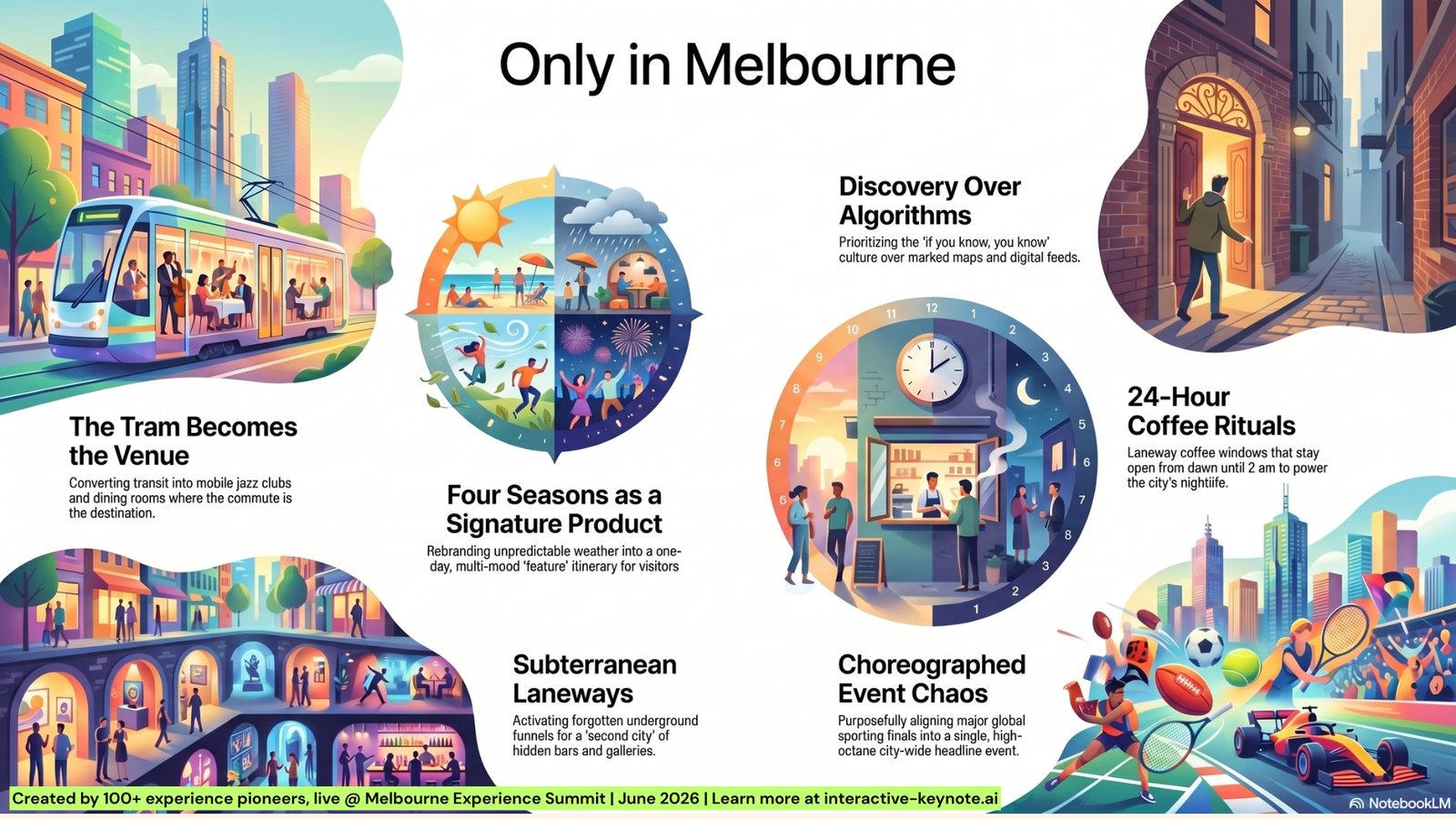
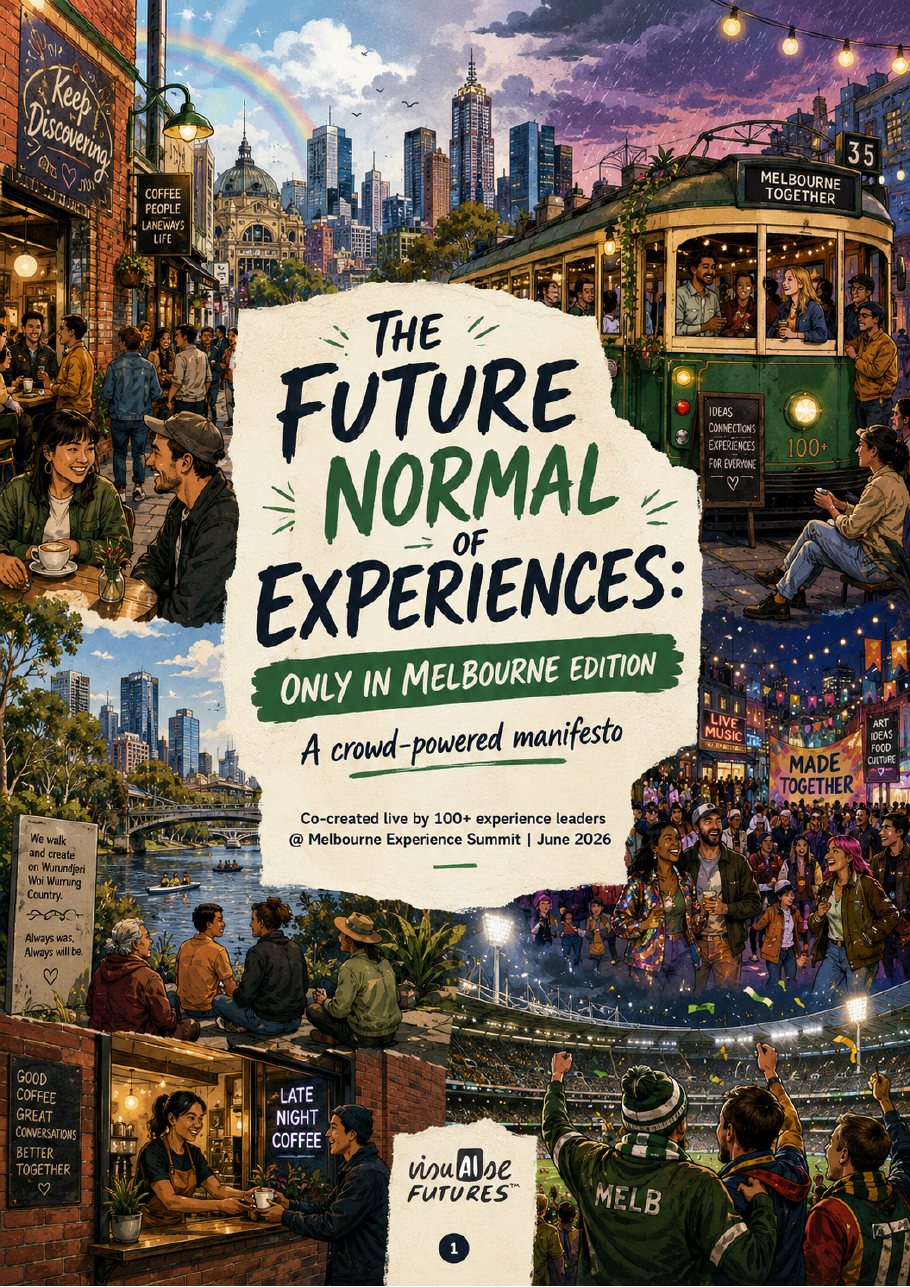
Only in Melbourne – a one-page infographic synthesising the room's ideas at the Melbourne Experience Summit
The room's "Only in Melbourne" declarations, rendered as a single shareable infographic – generated from the audience's own ideas, minutes after the session.
3The provocations the room drew

Four non-obvious "what ifs".

Beyond the consensus, the sketches surfaced some genuinely novel ideas – the kind no destination-marketing workshop would surface.

?

What if Melbourne ran a second city underneath the first?

DoubleCity imagined a parallel experience network below street level; SubTerra turned forgotten tunnels into gamified event trails; UnderPass and SubLanes activated the city's vaults and undercrofts as a venue grid. Not one underground bar – an entire subterranean twin of the city, unlockable by those in the know.

Theme: Laneways & Underground · 27.0%
?

What if four seasons in one day was the ticket, not the apology?

FourCast – sketched independently three separate times – re-packages the city's notorious weather as a one-day, multi-mood itinerary: sun, wind, rain and night, each with its own experience layer. The most-mocked sentence in Australian small talk, redesigned as the headline act.

Theme: Four Seasons & 24-Hour City · 19.1%
?

What if the oldest story in the city became its most modern experience?

BirrarungEchoes sketched an interactive Wurundjeri cultural journey along the river; Nura Tram put an Indigenous culinary journey on rails; BirrarungWalk made 60,000 years of story walkable. First Nations & Heritage was one of the quietest themes by volume – and one of the most distinctive by conviction.

Theme: First Nations & Heritage · 11.2%
?

What if the city's sporting chaos was choreographed on purpose?

QuadArena crams four world championships into a single day in one adaptive stadium; OmniWall keeps every global final on an always-on public display; MatchdayPath and ArenaSpur move the crowds between them. The room didn't want to calm Melbourne's event mayhem – it wanted to conduct it.

Theme: MCG & Live Sport · 31.5%
4Where the room placed its bets

215 ideas. Two questions. Two very different maps.

Every submission was analysed and clustered live, and each question earned its own published report. Toggle between the two distributions – the contrast is half the story.

MCG & Live Sport
31.5%
The 'G isn't a stadium – it's the city's beating heart, and everyone wants in.
Coffee & Café Culture
28.1%
Coffee isn't a drink here – it's the format every other experience borrows.
Laneways & Underground
27.0%
The best of Melbourne is the bit you can't see from the street.
Gamified Discovery & Quests
25.8%
Don't show me the city – make me unlock it.
Trams as Mobile Venues
24.7%
The tram stops being transport and becomes the destination.
Culinary & Food Culture
20.2%
The table is where Melbourne's cultures actually meet.
Four Seasons & 24-Hour City
19.1%
Melbourne's weather bug, reframed as the killer feature.
Yarra & Waterfront
18.0%
The Birrarung as the spine the whole experience hangs off.
Walkable Festivals & Street Takeovers
15.7%
Close the road, and the whole city becomes the venue.
Street Art & Creative Culture
13.5%
The laneway wall as Melbourne's signature canvas.
First Nations & Heritage
11.2%
The oldest story in the city, finally made walkable.

Total coverage exceeds 100% – most ideas spanned multiple themes, reflecting the integrated, systems-level thinking of participants. Percentages quoted verbatim from the two published Data & Insight Reports.

5Same room, two questions

What changed when the question got specific.

The warm-up asked the room to think globally about 2030. The second question asked what only Melbourne could host. Laying the two distributions side by side is where this dataset gets really interesting.

Asked about 2030…

Food topped the world list. Culinary & Dining led at 24.6% – supper clubs, street-long feasts, dinners cantilevered off skyscrapers. The table is the most reliable way to get anyone off the couch.

Asked about Melbourne…

The table started moving. Food came back at 20.2% – but it boarded a heritage tram (TramMystère), landed on the turf of the 'G (PitchPlate), and hid behind an unmarked laneway door (IYKYK Melbourne).

The table is the universal hook. The place is the multiplier.

Asked about 2030…

Technology was the spectacle. Immersive & Creative Tech hit 23.0% – holograms at memorials, VR you have to stand up to use, projection mapping on public walls.

Asked about Melbourne…

Technology went backstage. The headsets all but vanished. Tech re-emerged hidden inside quests, unlockable trails and city-scale games (25.8%) – the game-master you never see.

On the world stage, technology dazzles. At home, it deals the cards.

Asked about 2030…

Wellness was a top-three theme. At 23.0%, restoration was pitched as the cure for the couch – outdoor yoga, sensory grounding, screen-free retreats.

Asked about Melbourne…

Wellness didn't make the team. Among 89 "Only in Melbourne" ideas, restoration has no theme at all. The city of 24-hour coffee and choreographed event chaos never once pitched itself as the place you recover.

Melbourne's most interesting absence – see the white space below.

Asked about 2030…

Transit stayed generic. Transit & Spatial Dynamics tied for second at 21.4% – "the journey stops being dead time" – but it was drawn as anonymous pods, gondolas and ziplines.

Asked about Melbourne…

Transit got a name: the tram. At 24.7%, it became the single most-repeated object in the entire dataset – a stage, a restaurant, a dating app and a festival, all on rails the city already owns.

Ask a sharper question, get an ownable answer.

That last row is the method's quiet lesson. The generic question surfaces the levers anyone can pull – food, technology, restoration. The specific question surfaces the assets only you own – the tram, the 'G, the laneway, the weather. The first tells you what people want; the second tells you why they should come to you for it.

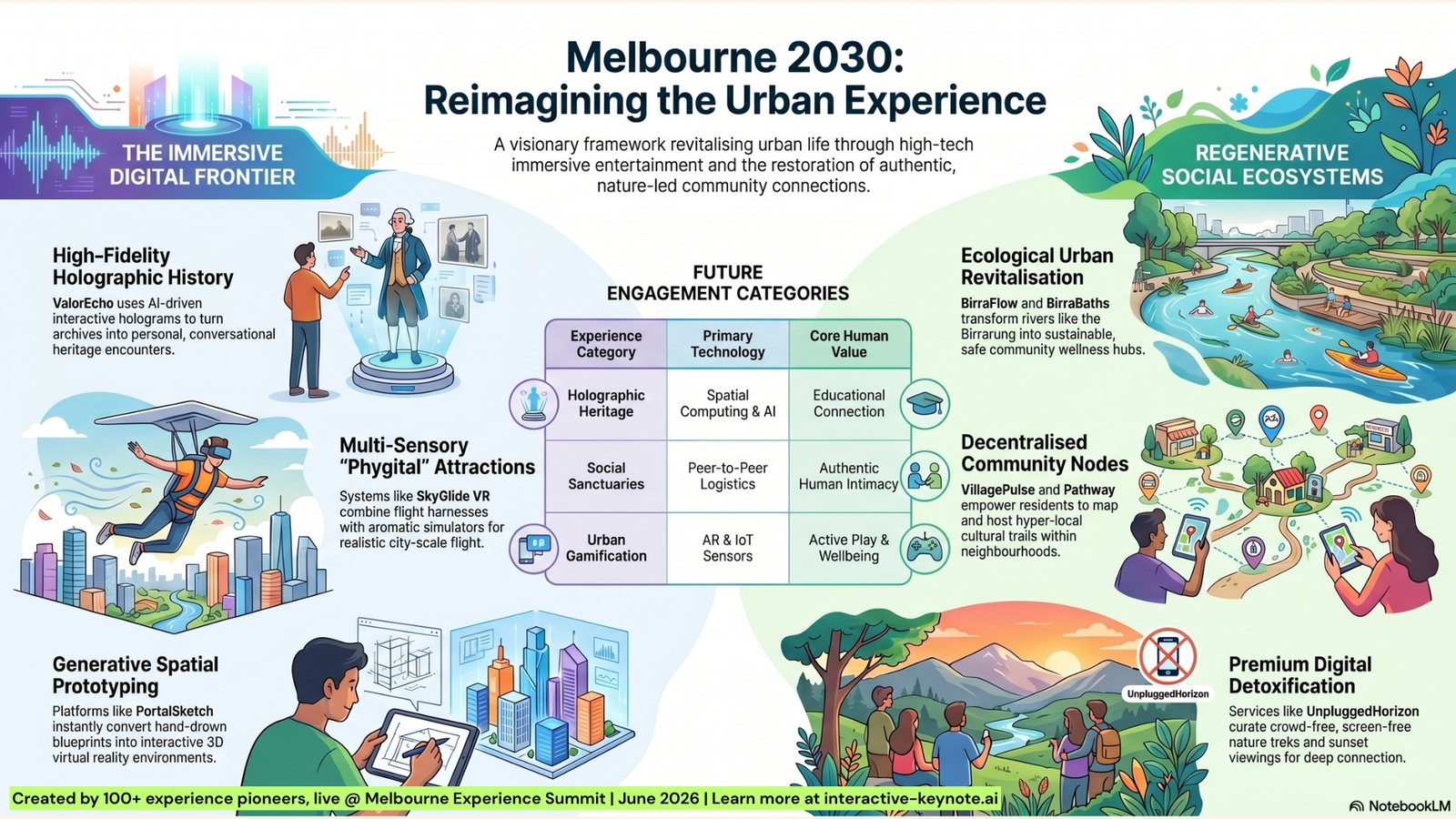
Melbourne 2030: Reimagining the Urban Experience – infographic synthesising the warm-up question's ideas
The warm-up question got its own infographic too – "Melbourne 2030: Reimagining the Urban Experience", generated from the room's first 126 ideas.
Bonus dispatch from Melbourne

The manifesto, inked as a comic.

Because a signal report can be a data table – or it can be a seven-page crowd-powered manifesto in graphic-novel form. The tram becomes the venue, the flat white that built the city's mornings powers its nights, and the weather becomes the headline act.

Only in Melbourne manifesto comic – page 1 of 7

Flip through all seven pages – or download the full manifesto.

6Tensions worth sitting with

Where the room disagreed with itself.

The most strategically valuable signals aren't the consensus – they're the places where 215 ideas pull in opposite directions.

The iconvs.The secret

The two strongest Melbourne instincts pull in opposite directions. MCG & Live Sport (31.5%) leans into globally famous Melbourne – the 'G, the Grand Prix, the spectacle. Laneways & Underground (27.0%) leans into the hidden, IYKYK Melbourne only locals know. Both are authentic. The question for every operator in the room: does your experience trade on fame – or on insider access?

Dazzlevs.Restore

In the 2030 set, Immersive & Creative Tech and Wellness & Personal Care tied at exactly 23.0% – and disagree about everything. One wants brighter, louder, more sensory; the other wants slower, quieter, screen-free. Both get people off the couch. They simply disagree on whether 2030 needs more stimulation or less – decide which couch you're actually competing with.

Move themvs.Make them linger

Trams (24.7%), quests (25.8%) and street takeovers (15.7%) want people in motion – riding, roaming, unlocking. Café (28.1%) and culinary (20.2%) want them to stop and stay. The richest Melbourne experience probably choreographs both: the journey between, and the table at the end of it.

7The white space

What 215 ideas didn't sketch. Yet.

The prompts asked for the experiences they wished existed – so these absences are invitations, not oversights. They're exactly where the next advantage hides.

Open opportunity № 1

The 24-hour city never sketched its recovery.

Ask this room about 2030 and wellness is a top-three theme (23.0%). Ask about Melbourne and it disappears: among 89 ideas there's no laneway sauna, no Birrarung bathhouse, no morning-after ritual for the choreographed event chaos. The city that perfected the third place hasn't claimed the restorative one.

What if Melbourne owned the wind-down as confidently as the night out? The 2030 set already sketched the raw material – river baths, sensory grounding, phone-free dinners. The first operator to pair the city that never stops with the experience that lets you stop claims a genuinely unclaimed position.

Open opportunity № 2

Every idea lives within cooee of a tram stop.

The prompt said Melbourne, and the room obliged – 89 ideas anchored to the 'G, the laneways, the river, the grid. Fair enough. But the playbook the room invented – unlock the hidden layer, turn shared infrastructure into a stage, make the weather the point – currently stops at the city's edge.

What if "only in Melbourne" became "only in…" everywhere? For a state whose experience economy stretches from the Great Ocean Road to the High Country, every region has its own laneway and its own IYKYK trail. The first regional operator to run this playbook imports a decade of city thinking overnight.

8Take it back to the team

Three provocations for your next strategy session.

Anchor to an icon, then subvert it.

The strongest ideas took something unmistakably Melbourne – the 'G, a tram, a laneway – and did the last thing you'd expect with it: dinner on the turf, speed dating between stops, a city underneath the city. What's the piece of your world your audience already knows by heart – and what's the last thing they'd expect you to do with it?

Run the two-question test.

This dataset exists because the same room was asked twice: once about the category, once about the place. The generic answers found the levers – food, tech, restoration. The specific answers found the assets – the tram, the 'G, the weather. Run both questions on your own strategy; the overlap is where you should be building.

Turn shared infrastructure into a stage.

Trams, bridges, tunnels, the river – the room kept reaching for civic infrastructure everyone already shares. What's the under-used piece of public space in your patch that could become a venue overnight – and what would it take to be first?

9Were you in the room?

Your sketch is in here. Go find it.

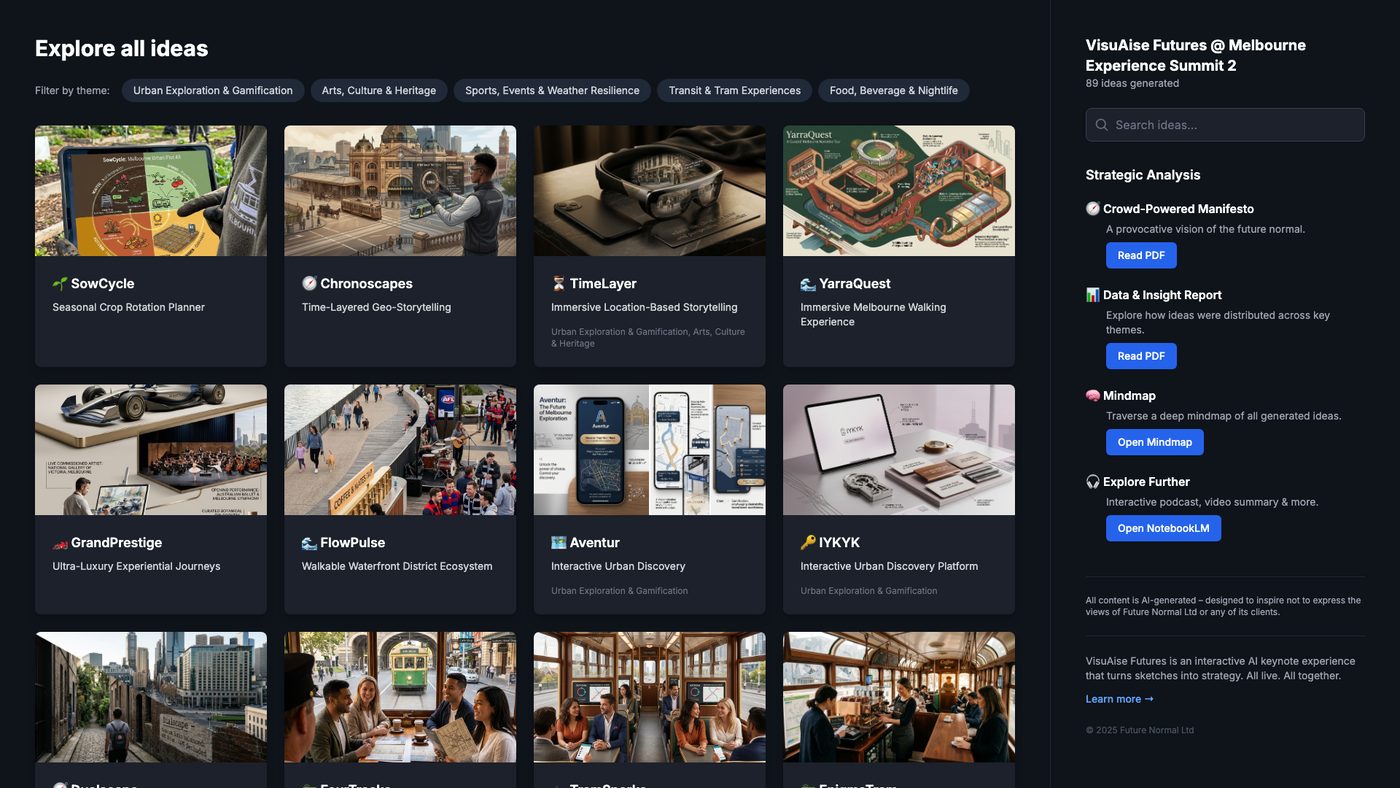
Every idea has its own page – concept images, AI roast, shareable idea card, and a full Deep Innovation report assessing feasibility and a draft launch plan. Both questions, both portals.

Straight from the room

What the pioneers in the room actually felt.

Unfiltered, opt-in feedback captured live at the Melbourne Experience Summit – 65 responses, 95% rated the session valuable.

A fascinating and eye-opening insight on how to use AI for creativity. A refreshing change from the negative talk around AI of late.

A wonderful opportunity to break down a perception I had about AI without ever properly educating myself.

Finally an actionable use of AI for experimental ideation.

Compelling, inspiring – triggered ideas I can implement in my business.

Loved to see how AI enables in such a powerful manner. Very insightful.

Insight in how to use AI to tap into our staff and colleagues, and present and curate ideas.

A reminder of how important it is we are creative in finding ways to include all voices.

Liked the uniqueness of the session. Really enjoyable.

– Lara Leigh · Melbourne Skydeck

A fascinating and eye-opening insight on how to use AI for creativity. A refreshing change from the negative talk around AI of late.

A wonderful opportunity to break down a perception I had about AI without ever properly educating myself.

Finally an actionable use of AI for experimental ideation.

Compelling, inspiring – triggered ideas I can implement in my business.

Loved to see how AI enables in such a powerful manner. Very insightful.

Insight in how to use AI to tap into our staff and colleagues, and present and curate ideas.

A reminder of how important it is we are creative in finding ways to include all voices.

Liked the uniqueness of the session. Really enjoyable.

– Lara Leigh · Melbourne Skydeck

Read all the unfiltered attendee feedback →

10How this was made

From sketch to strategy. Twice. In one hour.

No app. No survey. No consultants. Henry didn't even need to be in the room – he joined the summit remotely while 100+ people sketched, scanned and co-created on site. Just pens, paper, a QR code – and an audience doing what no live poll has ever managed: thinking out loud, together.

1.

Doodle

Everyone sketches their idea. Pen and paper. No artistic skill required.

2.

Capture

Scan a QR code, photograph the sketch. No app, no login.

3.

Transform

AI turns every sketch into polished concepts – shown live on the big screen.

4.

Explore

Themes, tensions and insights emerge from the collective input – in minutes.

You've just experienced the transformational power of AI-native thinking and doing. Strategy engagements used to take months to assemble these insights, but the audience produced the raw material live, mid-keynote – and the analysis you're scrolling was in their hands while the room was still buzzing.

VisuAIse Futures shows 10x thinking in action: the keynote stops being a broadcast and becomes a shared experience. Your audience stops being spectators and becomes your strategy team. And because they co-created every artefact on this page, they want to engage with it afterwards – psychologists call it the IKEA effect; event organisers call it post-event content people finally open.

Henry Coutinho-Mason
What would your audience draw?

Every industry has a future its people can already see – they've just never been asked to sketch it. If you're planning a conference keynote, leadership offsite or customer event, let's turn your next audience into your strategy team.