At SBS Connect in London, we handed a room of 100+ finance leaders a blank page and one provocation: imagine a future moment you'd love to create – then draw it, or the tool that makes it possible. Two industries – retail banking and specialised finance – that experience AI completely differently. No survey, no committee, no consultants. This is what their collective intelligence revealed.
Real, unretouched sketches from the room – tap any one to reveal the AI-generated concept it became.
Retail banking and specialised finance experience AI completely differently – one humanising trust at scale, the other orchestrating ecosystem complexity. Yet strip the brand names off 85 sketches and the two biggest clusters say the same thing: this room is at war with the calendar. The Self-Running Back Office (22%) and Collapsing Timelines (21%) together touch more than four in ten ideas. The drudgery – reconciliation, month-end, the slide deck nobody wanted – goes to the machine. What everyone fights to protect is the human work: judgment, trust, the conversation that earns the deal. The room didn't draw the robot banker. It drew the back office disappearing, so the banker could come back.
Every insight on this page is drawn directly from the audience's own submissions – sketched live, transformed by AI, analysed while the room was still buzzing. Theme percentages are quoted verbatim from the published Data & Insight Report.
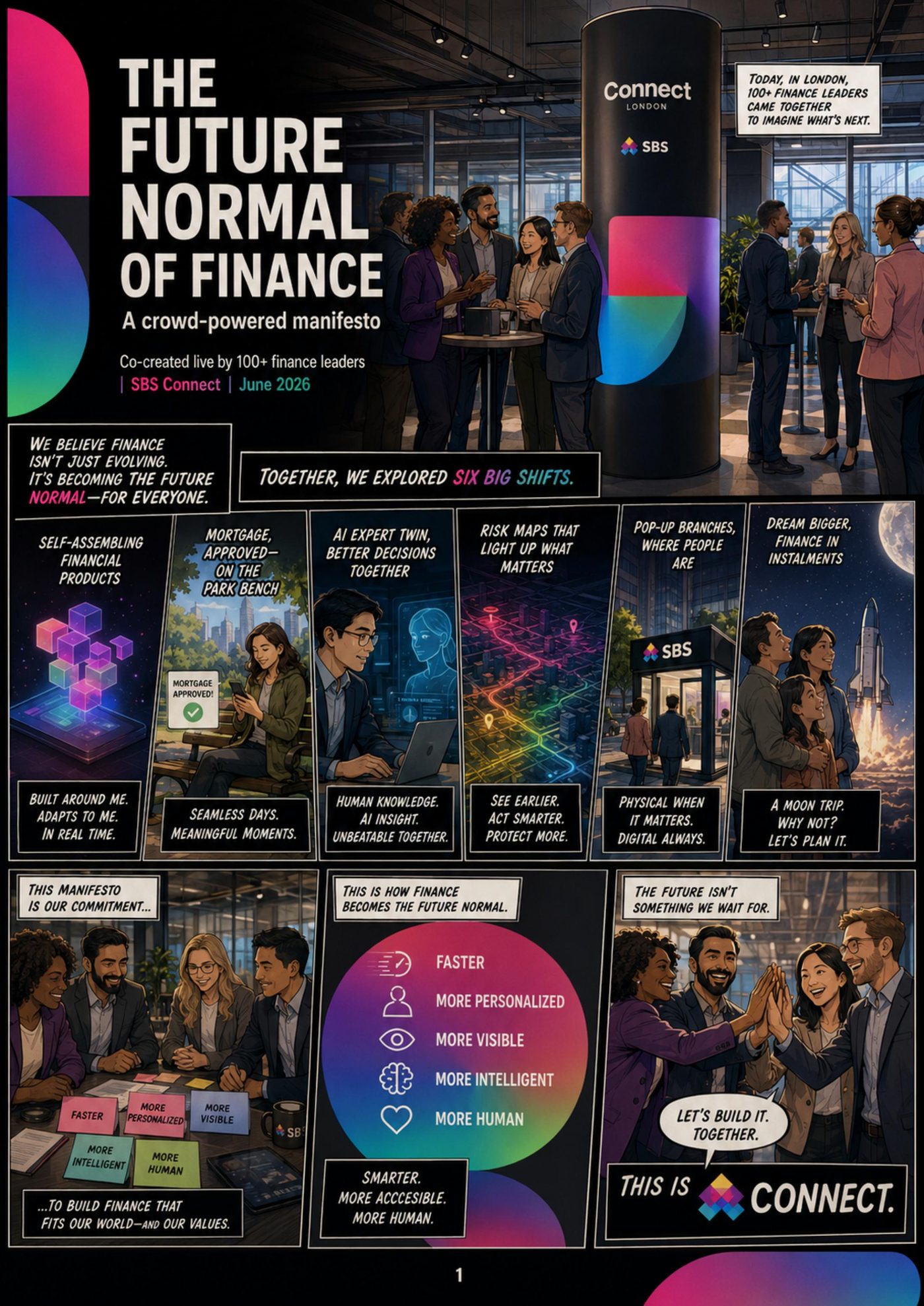
Read together, the sketches stop being individual wishes and start sounding like a shared declaration – a crowd-powered manifesto for what finance wants from AI.
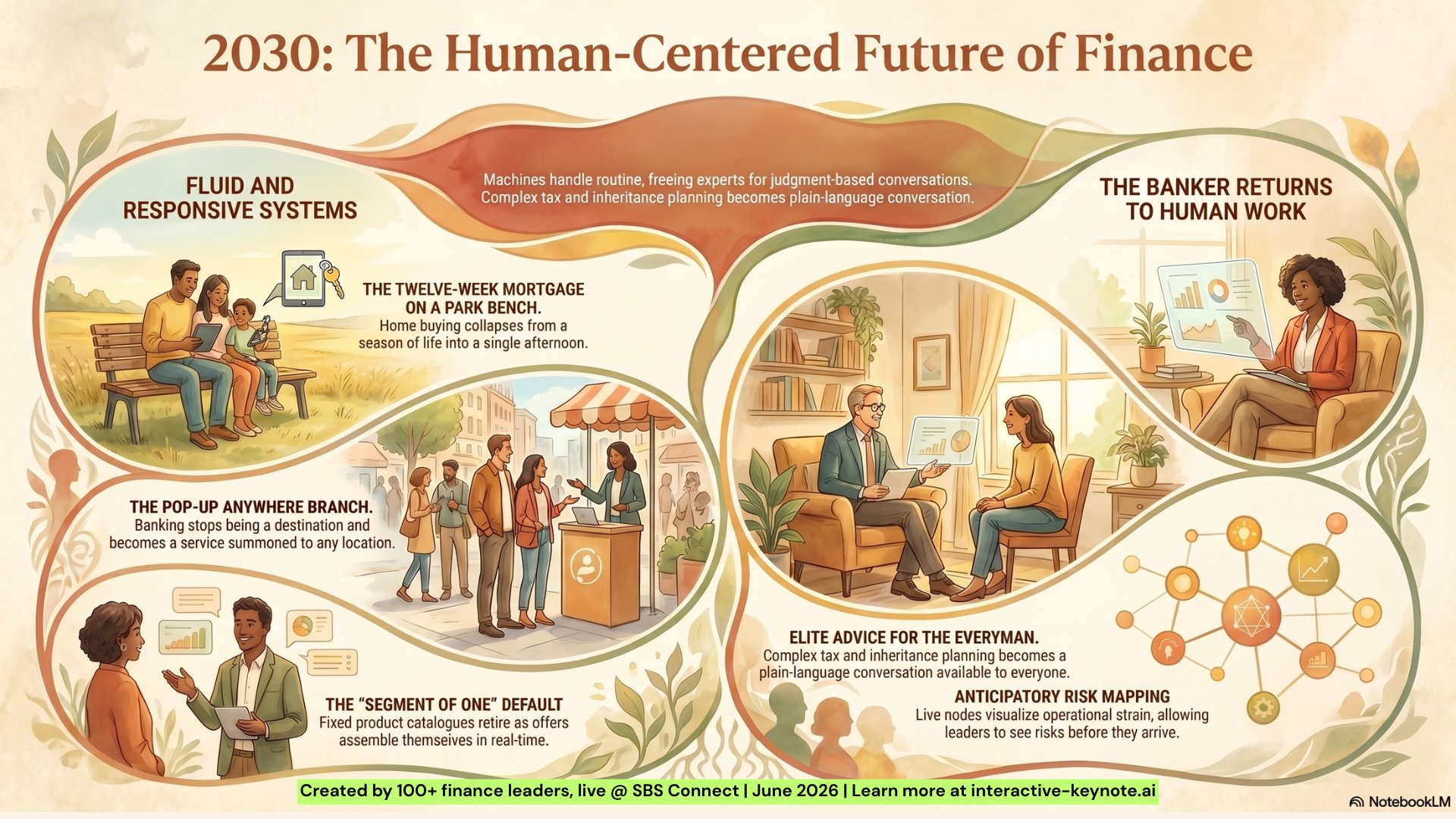
The room's deepest shared wish was simple: delete the wait. The twelve-week mortgage closes on a park bench. Weeks of multi-party negotiation settle in a twenty-minute session. Multi-week audits run in hours. Speed – not features – is the category these leaders believe they're competing in.
From the room: InstaNest – the month-long mortgage, collapsed · SwiftKey – property transactions in a single day · Accordis – weeks of negotiation, settled before lunch
The automation appetite is huge – but precise. The invisible grind that eats the working week – reconciliation, month-end, policy updates, compliance, the deck nobody wanted to build – moves to the machine, with humans supervising rather than doing.
From the room: LiberateOps – the mundane, automated · SwiftVerify – multi-week audit cycles, in hours · EchoLedger – conversational accounting
The expertise locked in a few experienced heads – tax, trusts, estate, whole-of-life – gets handed to everyone, on demand, in plain language. Its sibling wish: the same democratisation inside the building, where good judgment is no longer rationed by who's in the room.
From the room: LifePath – democratised high-end wealth advice · TailorBank – the "segment of one", priced in real time · LegacyFlow – estate planning, de-cluttered
With the drudgery gone, the banker, the adviser and the agent return to what only people do: the judgment call, the reassurance, the hard conversation on the worst day of someone's year. Freeing People (7%) and Reinventing Customer Service (7%) are the same instinct from two ends.
From the room: DirectHuman – skip the chatbot, reach a person · EchoTable – support for the grieving · CuraNavigator – the empathetic guide
Beyond the consensus, the sketches surfaced genuinely novel ideas – the kind no industry roundtable would ever produce.
A cluster of leaders sketched finance that senses the human nervous system, not just the credit file. Vitalic correlates live biometric signals with decisions; PulseDeal reads emotional intelligence in real time; ApexPOV simulates the stress of a high-stakes call. Powerful – and the surveillance question nobody fully answered.
Theme: emotion & wellbeing techThe room kept returning to the worst moments – and asked AI to make them bearable. EchoTable sketched emotionally-supportive hardware for the grieving; CuraNavigator guides patients through fragmented health-and-finance systems; LegacyFlow de-clutters the estate. Not efficiency – grace.
Theme: the hardest conversationsIn a room full of competitors, someone drew the shared rail. AutoNexus sketched an open, decentralised protocol to unify the fragmented motor-finance ecosystem – dealers, OEMs and lenders all reading one truth. It answers specialised finance's quiet question: who owns the customer when you never touch them directly?
Theme: the open ecosystemHand finance leaders a blank page and a fifth of the room leaves the planet. TelePortal and VeloPort collapse distance; LunaPass and LunaTransit finance space tourism for everyone, not just billionaires. The most commercial idea in the whole set was born here: "buy now, pay later… to the moon."
Theme: space & moonshotsEvery submission was analysed and clustered live, each idea tagged against every theme it genuinely spans. Here's the distribution – and what each theme signals.
Percentages quoted verbatim from the published Data & Insight Report (85 ideas, each tagged against every theme it genuinely spans). Total coverage exceeds 100% because most ideas span multiple themes, reflecting the integrated, systems-level thinking of participants. Four off-cluster ideas – chairs, a satnav, a brain-computer interface and a university chooser – sat outside every theme.
SBS Connect put one provocation to two very different rooms at once: retail banking and building societies, who live on long-term customer trust; and specialised and asset finance, who orchestrate sprawling dealer, broker and OEM ecosystems. They walked in asking different questions. They sketched their way to the same answer.
What they drew: humanising and personalising at scale – the mortgage collapsed to an afternoon, private-bank advice handed to everyone, the branch summoned to a street corner, a real person always reachable behind the chatbot.
What they drew: orchestrating a fragmented ecosystem – self-documenting dealer credit, an open data protocol everyone can read, multi-party negotiations settled before lunch, operational risk you watch spread on a live map.
Because a signal report can be a data table – or it can be a seven-page crowd-powered manifesto in graphic-novel form. Four declarations, four what-ifs, one closing argument. Proof that strategic doesn't have to mean dry.

Flip through all seven pages – or download the full manifesto.
The most strategically valuable signals aren't the consensus – they're the places where 85 ideas pull in opposite directions.
The room wants everything in 24 hours – yet finance runs on the very checks that take time: underwriting, due diligence, compliance, consumer duty. Push speed too hard and "frictionless" quietly becomes "unchecked". The room automated the decision; almost nobody automated the appeal. The design challenge isn't to remove the controls – it's to make them invisible.
The single most repeated wish was time for "creative human interaction with customers" – voiced by the same people who want the back office fully self-running. Half the room sketched AI as the colleague that frees people up; half sketched the zero-touch system that removes them. Both can't be the plan. Where, exactly, do you stop automating? Resolution lives at the boundary of empathy and judgment.
Hyper-personalised products, a single view of the customer, life-stage offers, even emotion-tracking – all demand deep data. The more the bank knows, the better the offer, and the closer it edges to surveillance. The unlock is consent that feels like care, not capture. Whoever gets that feeling right gets the data – and the decade.
The provocation asked for the future they wished existed – so these absences are invitations, not oversights. They're exactly where the next advantage hides.
For an industry defined by regulation – fairness, transparency, consumer duty – almost nobody drew AI that turns compliance from a tax into a feature. PolicySwift and SwiftVerify automated the audit; no one sketched the AI that proves fairness to a regulator in real time, or explains a declined application to the customer in plain English.
What if "explainable by default" were the product, not the patch? The first lender that can show its working – to the regulator and to the rejected applicant – earns the trust every competitor then has to buy.
Asked for the tool they wished existed, the room drew velocity, personalisation and convenience – and as finance collapses to a single afternoon, so does the attack surface. Only a couple of sketches (VeriSocial, one cyber-wellness idea) touched fraud and the dark side at all.
What if the same AI that collapses the mortgage also closed the fraud window it opens? Speed without safety isn't a feature – it's a liability with a nicer interface. Ship them together, and you're the only one who gets to move fast.
Don't boil the ocean. Choose the single journey where the wait hurts most – a mortgage, onboarding, a dealer credit decision, a dispute – and rebuild it for hours, not weeks. Start by mapping where the days actually go today. The room voted with its pens: speed is the category you're competing in.
Decide explicitly which tasks move to the machine – reconciliation, month-end, policy, decks – and which stay human: judgment, trust, the deal-winning conversation. Make it a stated principle, not an accident of tooling. The bank that draws this line on purpose keeps its best people; the one that lets the tools draw it loses them.
For each speed ambition, name the trust work that earns it – embedded risk, real-time validation, consent baked in, an explanation the customer and the regulator both accept. Speed without trust is just risk with a nicer interface. And treat the off-brief ideas – the park-bench mortgage, the holiday to the moon – as a horizon-two track, not clutter. They're the room showing you where delight lives.
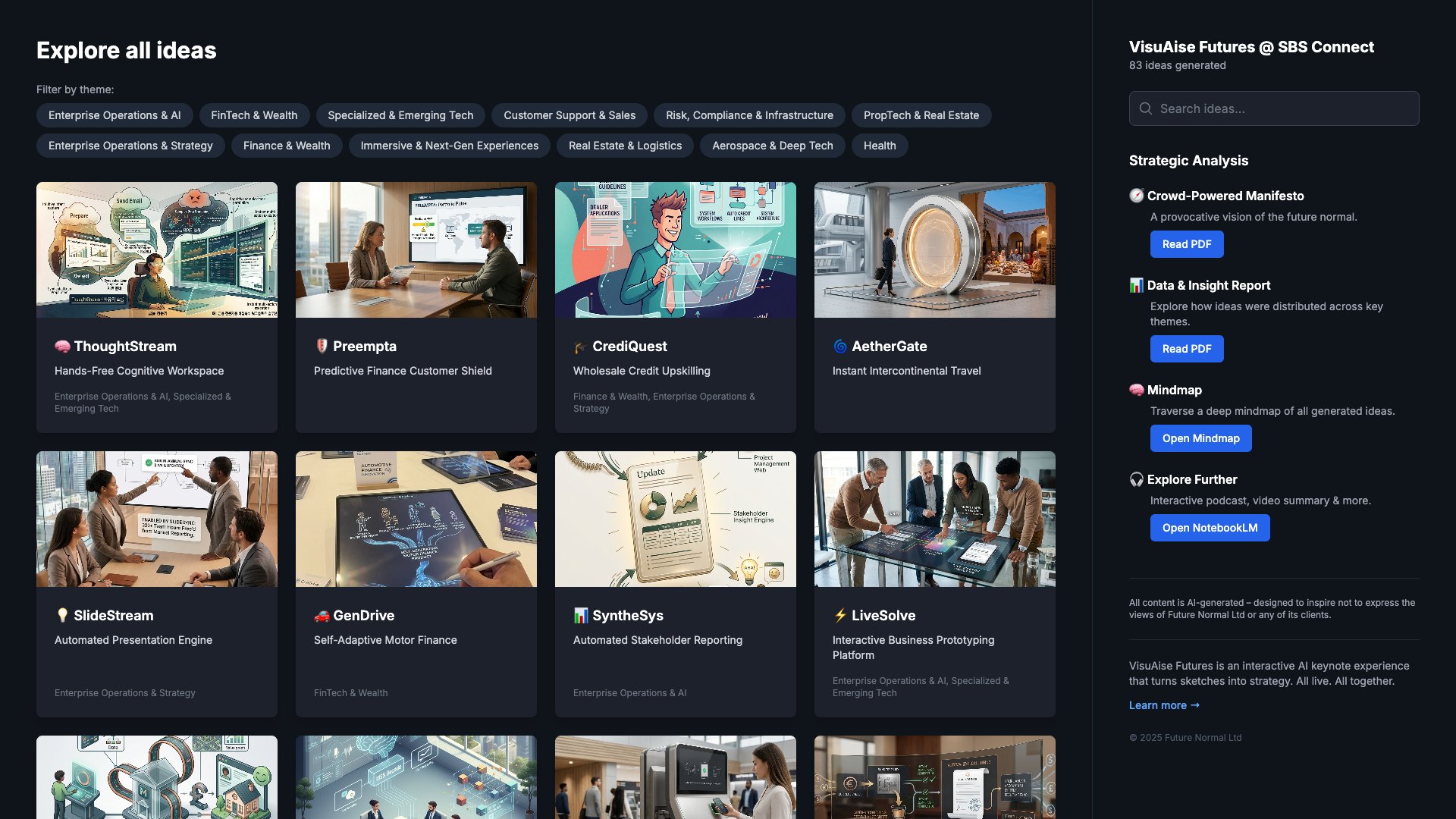
Every idea has its own page – AI concept images, an AI roast, a shareable idea card, and a full Deep Innovation report assessing feasibility with a draft launch plan.
Answer three quick questions and we'll point you to the ideas in the dataset most worth your attention – quite possibly including your own.
Download a single consolidated .md file and drop it into your LLM of choice, ready to query for insights related to your current projects.
Henry's full SBS Connect presentation – The Future Normal of Finance – yours to download and revisit.
“Henry delivered an outstanding keynote at our client event in London. What makes Henry unique is his ability to make complex topics such as AI accessible, engaging, and memorable. He combines deep insight into emerging technologies with humor, storytelling, and practical examples that resonate with audiences of all backgrounds.”
Unfiltered, opt-in feedback captured live at SBS Connect – 41 responses, 98% rated the session valuable, and 100% would hear Henry again.
Thought provoking and perfectly pitched for the audience.
Brings AI up a level – to the premise, rather than assumed detailed applications.
Positive thoughts on how AI will change our lives.
Great session to think about the future.
Really energetic and insightful.
Brilliant, very engaging.
Really eye opening.
Revelatory.
Very interactive.
Eye opener, inspiring.
Awesomeness, inspiring.
Thought provoking and perfectly pitched for the audience.
Brings AI up a level – to the premise, rather than assumed detailed applications.
Positive thoughts on how AI will change our lives.
Great session to think about the future.
Really energetic and insightful.
Brilliant, very engaging.
Really eye opening.
Revelatory.
Very interactive.
Eye opener, inspiring.
Awesomeness, inspiring.
No app. No survey. No consultants. Just pens, paper, a QR code – and an audience doing what no live poll has ever managed: thinking out loud, together.
Everyone sketches their idea. Pen and paper. No artistic skill required.
Scan a QR code, photograph the sketch. No app, no login.
AI turns every sketch into polished concepts – shown live on the big screen.
Themes, tensions and insights emerge from the collective input – in minutes.
You've just experienced the transformational power of AI-native thinking and doing. Strategy engagements used to take months to assemble these insights, but the audience produced the raw material live, mid-keynote – and the analysis you're scrolling was in their hands while the room was still buzzing.
VisuAIse Futures shows 10x thinking in action: the keynote stops being a broadcast and becomes a shared experience. Your audience stops being spectators and becomes your strategy team. And because they co-created every artefact on this page, they want to engage with it afterwards – psychologists call it the IKEA effect; event organisers call it post-event content people finally open.

Every industry has a future its people can already see – they've just never been asked to sketch it. If you're planning a conference keynote, leadership offsite or customer event, let's turn your next audience into your strategy team.
Or just email renee@ideapress-speakers.com