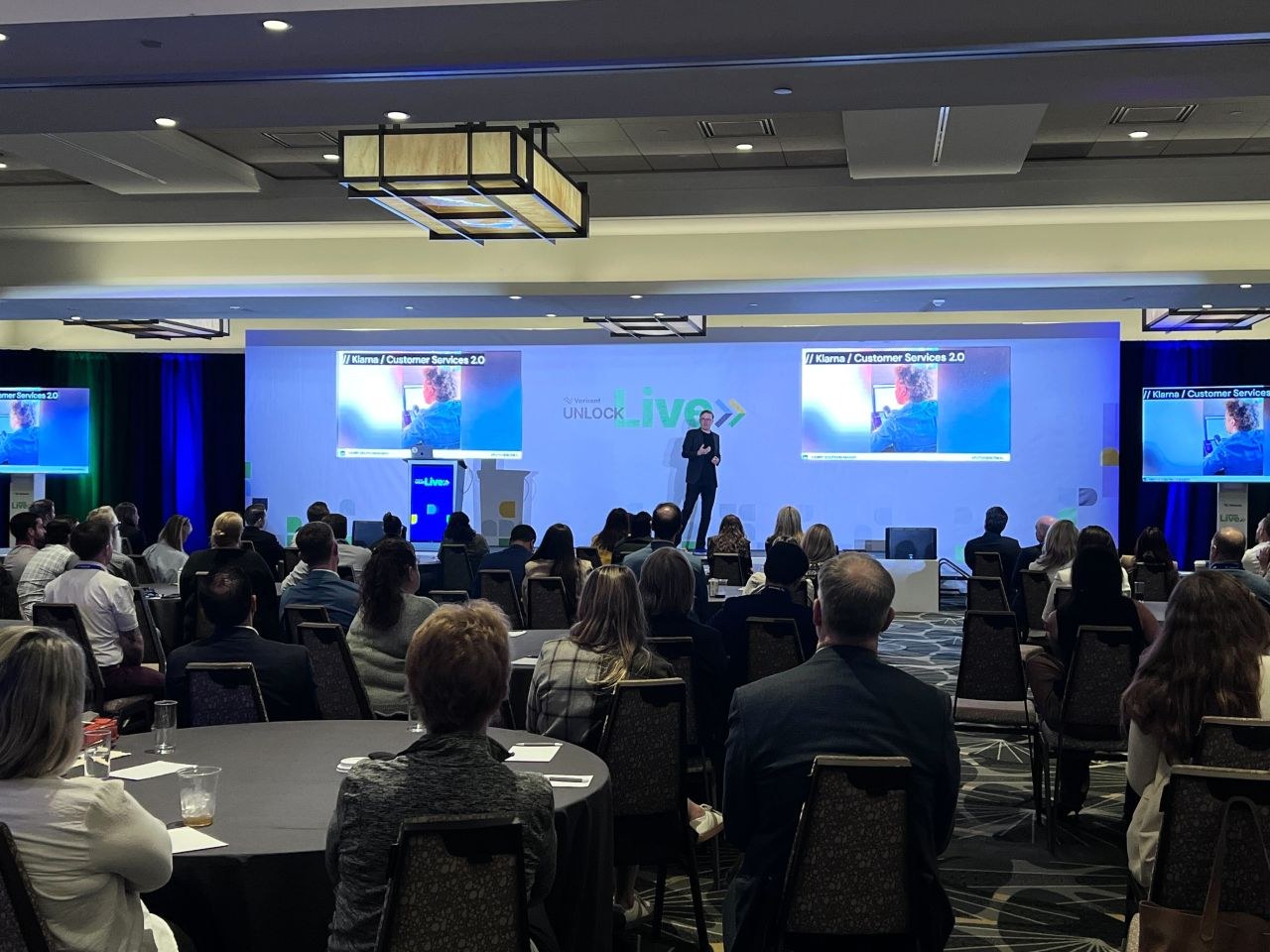
At Varicent's Unlock series of customer conferences, we asked 200+ revenue operations, sales comp and ICM leaders one question: sketch the tool you'll deploy in 2030, when AI handles the admin and your role turns strategic. This is what their collective intelligence revealed.
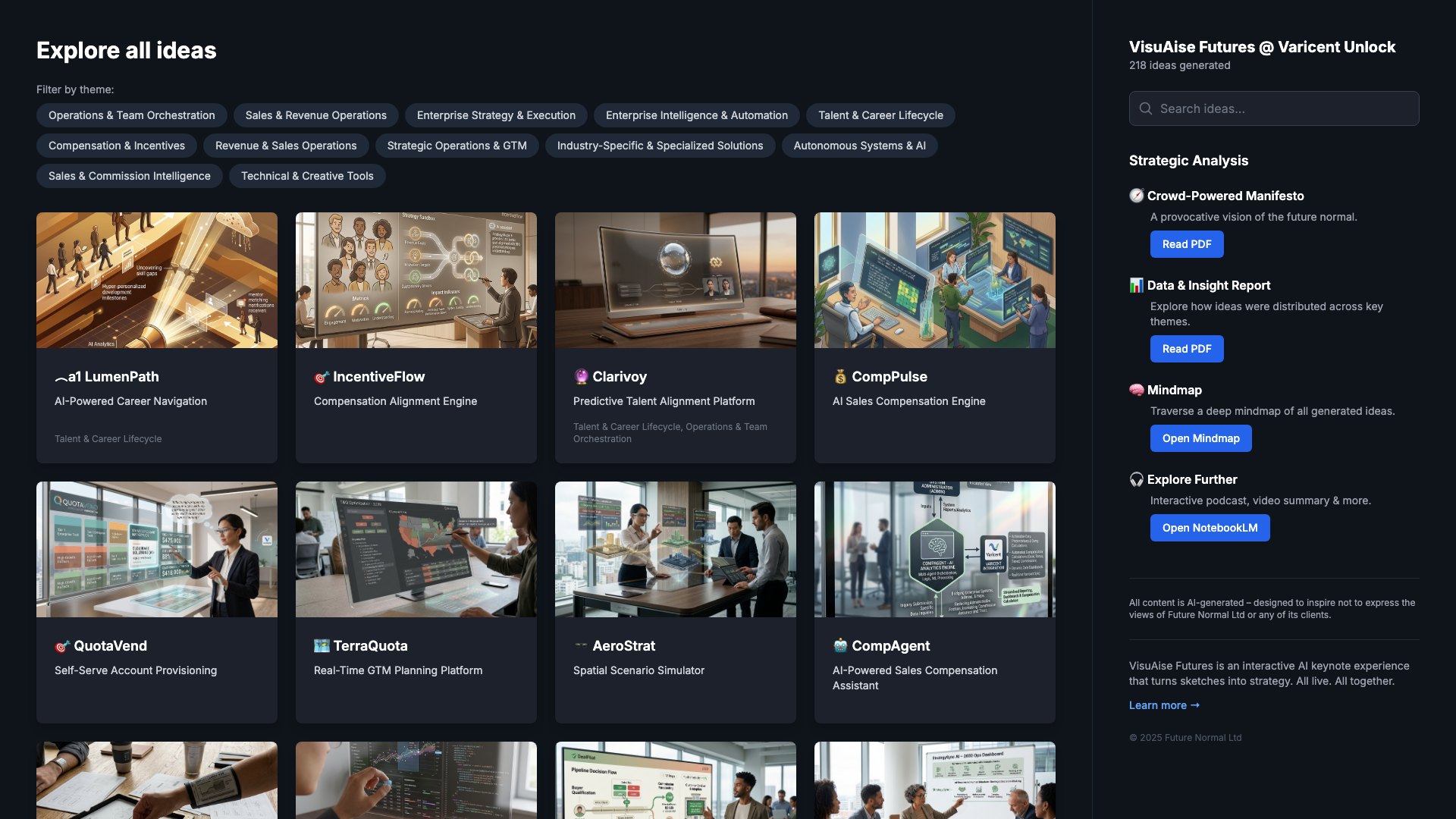
Real, unretouched sketches from the room – tap any one to reveal the AI-generated concept it became.
The single largest cluster – one in three ideas – wasn't a feature request. It was the death of the monthly report. Voice-built dashboards, ask-me-anything comp bots, ten hours of spreadsheet work collapsed into a conversation. The 2030 deliverable isn't a dashboard you read. It's a colleague you ask.
Every insight on this page is drawn directly from the 218 audience submissions – sketched live, transformed by AI, analysed within minutes of each session ending.
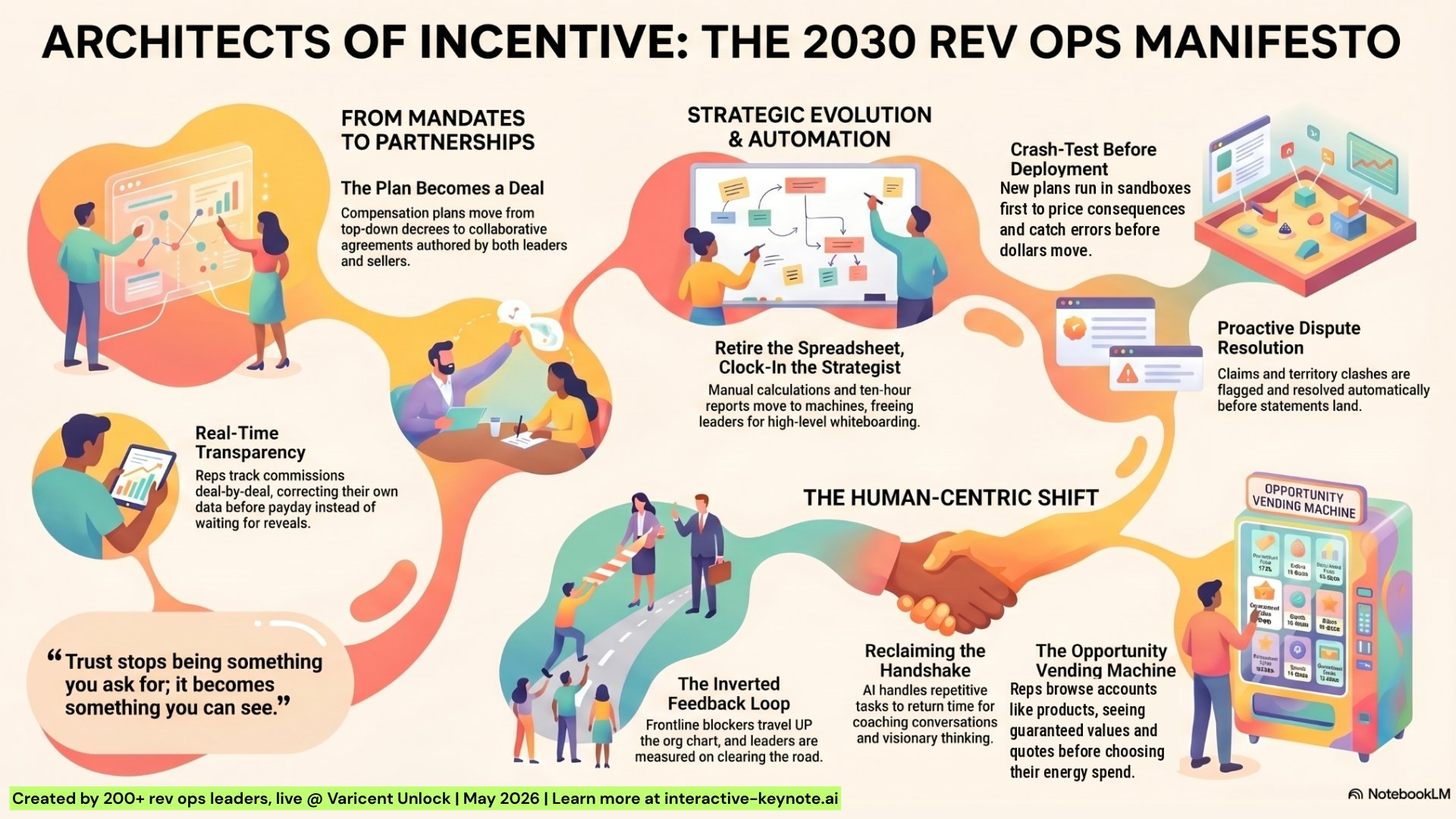
Read across all three cities, the sketches stop being individual wishes and start sounding like a shared declaration.
You stop building the answer and start asking for it – out loud, in plain English, the moment the question occurs to you. Reporting becomes a conversation with software that already read everything.
From the room: QueryFlow – "I have a question, here's the answer" · EchoBI builds reports by voice · CompFlow turns 10+ hours of monthly reporting into a live view
Static, annual, one-size-fits-all is over. Plans flex deal-by-deal, sellers co-author them as shared contracts, and commission appears the moment the order is entered. The plan stops being a decree – it becomes a living agreement that works for both sides of the table.
From the room: Pacto – "no more black-box plans" · FluidComp's win-win what-ifs · CommishNow pays at order entry
Errors caught before payday, not after. Disputes predicted, not litigated. One participant even sketched a live Fairness Index – a running score of how much sellers trust the plan. The black box doesn't just crack open; it gets a gauge bolted to the front.
From the room: TrustScale's Fairness Index · VeriPay Pro catches discrepancies pre-payday · EarnFlow's self-serve corrections
Nobody drew fear. They drew themselves freed: back in the field, coaching, thinking – even on the beach while their agents work the queue. This room isn't worried AI takes the job. It's impatient for AI to take the boring part.
From the room: SignalShift – "tactical tasks to visionary leader" · NexusField – back to handshakes · AgenticPay's analyst, on vacation, covered
Beyond the consensus, the sketches surfaced some genuinely novel ideas – the kind no roadmap workshop would surface.
One sketch – literally named BlindSpot – flips analytics on its head: the system digests your business overnight and arrives each morning with conclusions nobody queried. Insight stops waiting for the right question.
Sketched in BostonAn internal prediction market where sellers stake virtual money on whose pipeline will actually close. The crowd's odds become your most honest forecast – optimism bias rarely survives contact with a wager.
Sketched in DallasOne idea fused wearable health data with incentive design: plans engineered to drive revenue and sustainable human performance. Quota and wellbeing, on the same dashboard – peak output without the burnout.
Sketched in DallasFrontline reps push the real blockers straight to leadership through visible channels – and executives get measured on how fast they clear the road, not how hard they push the people on it. The cascade, inverted.
Sketched in LondonEvery submission was analysed and clustered live. Here's the full distribution – and what each theme signals.
Total coverage exceeds 100% – most ideas spanned multiple themes, reflecting the integrated, systems-level thinking of participants. That's a feature of the data, not a bug.
Same prompt, same method, three audiences. The shared direction is unmistakable – but each city left its own fingerprint on the future.
London sketched the politics of the system: fairness indexes, radical transparency, accountability flowing upward, and boardrooms staffed by AI agents debating around the table.
Signature sketch: TrustScale – a live dashboard mapping how much sellers actually trust the plan.
Dallas rewrote the contract: comp plans co-authored by the people they pay, self-serve corrections, disputes resolved before the statement lands, and pay that updates in real time.
Signature sketch: Pacto – "no more black-box plans… plans become shared contracts."
Boston built the colleague you ask: proactive insight, instant briefs, call-to-deck automation – and the boldest self-portraits of the analyst reinvented as strategist.
Signature sketch: BlindSpot – a system that "draws conclusions you didn't know to ask for."
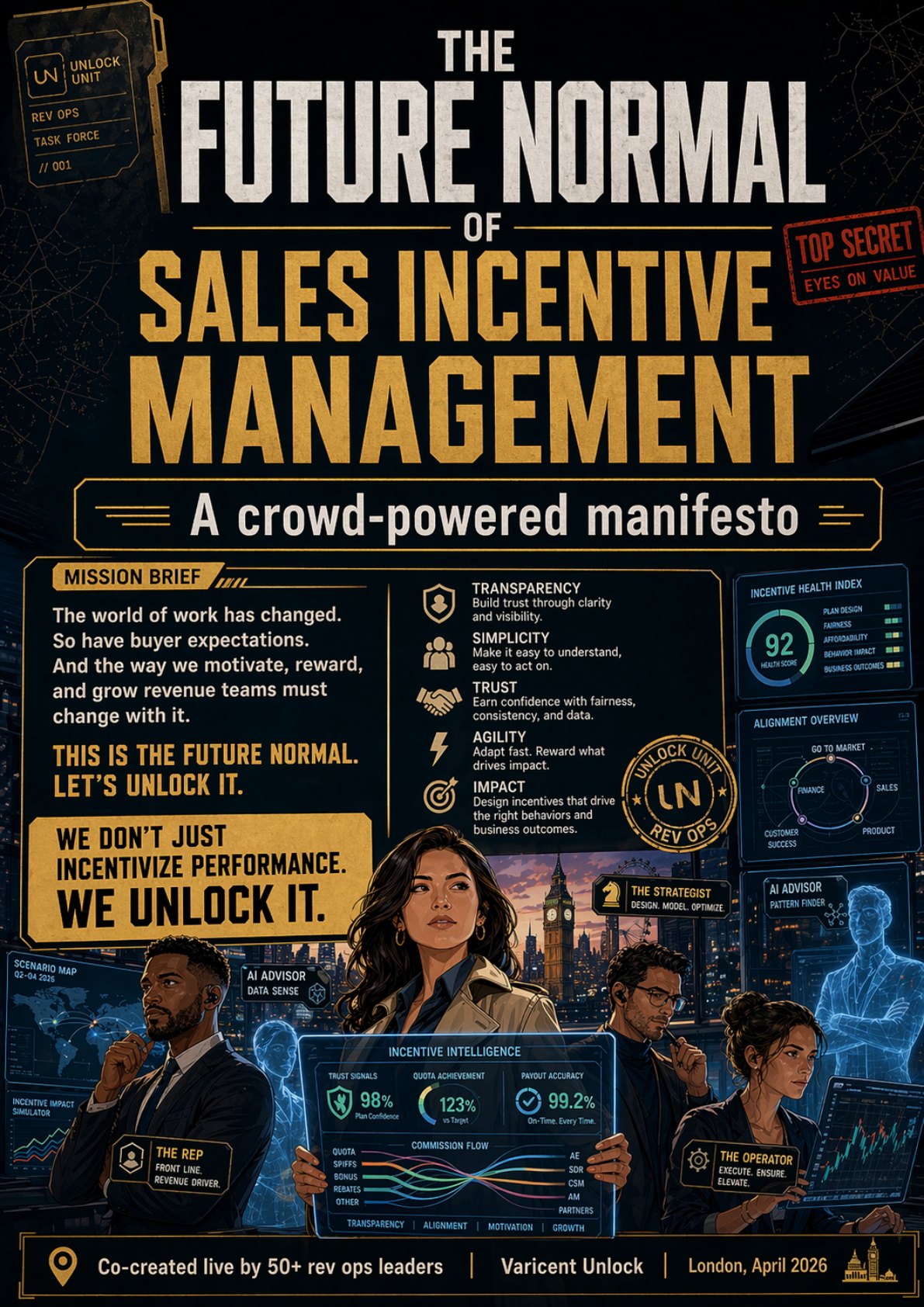
Because a manifesto can be a two-page declaration – or it can be a six-part "Rev Ops Task Force" mission brief. Same insights from the London room, reimagined as pulp. Proof that strategic doesn't have to mean dry.

Flip through all six pages – or download the full mission brief.
The most strategically valuable signals aren't the consensus – they're the places where 218 ideas pull in opposite directions.
One half of the room wants a single intelligent layer over everything; the other wants a workforce of specialist agents working in concert. Which model the industry backs decides who becomes the platform of record – and who becomes one agent inside someone else's.
The dominant dream is making operational work disappear. Yet a persistent one in ten ideas pulled the other way: as admin vanishes, selling returns to the field, the handshake, the relationship. The more convincingly AI removes the busywork, the more value concentrates where no algorithm can fake it.
Alongside the efficiency ideas sat a quiet wellbeing wish – from stress-to-harmony platforms to incentives that track healthy performance. Is the 2030 goal simply more with less – or better work, with less grind? This room wants both, and won't accept the trade-off.
The prompt asked the room about their own role – so these absences are invitations, not oversights. But they're exactly where the next advantage hides.
218 ideas about the future of revenue – and barely 3% put the actual customer in the frame. The room automated everything behind the curtain; almost nobody redrew what the buyer sees and feels.
What if the same machinery faced outward? The first rev ops team to give customers a window into the engine – transparent deal status, self-serve clarity, shared forecasts – doesn't just save admin. It builds a moat made of trust.
Fewer than one in fifteen ideas touched adoption, training, or the messy middle of change. The destinations are vivid; the journey got a single brave sketch – one that mapped "all the fear points" between here and there.
What if change-readiness were the product? Every vision in this dataset will be won by the teams who design the on-ramp: the first 90 days, the trust-building, the human hand-holds. Build the bridge, and you reach the future first.
A third of your most engaged users are telling you the report is the problem, not the solution. Pick one painful recurring report and ask: what would it take to simply ask for it – in words, out loud – and get a trustworthy answer? That's the 2030 interface, and this room has already designed it.
The highest-value, least-served wish in the data: model a plan change before it ships. A sandbox where leaders test territory, quota and incentive scenarios – and see the predicted seller behaviour – moves you from system of record to system of foresight. Start with one plan, one what-if, one room of beta users.
One in five participants sketched their own reinvention from operator to strategist – without being asked. That's a community ready to be led somewhere. What would it mean to promote the rev ops leader from chief calculator to chief revenue strategist – and to be the brand that says it first?
Every idea has its own page – concept images, AI roast, shareable idea card, and a full Deep Innovation report assessing feasibility and a draft launch plan.
Answer three quick questions and we'll point you to the ideas in the dataset most worth your attention – quite possibly including your own.
Unfiltered, opt-in feedback captured live at Varicent Unlock – 104 ratings, 100% positive.
Insightful and engaging – I left with a different perspective on my role and the future of my work.
That interactive session was incredible!
Engaging, thought provoking, energizing, memorable – an interactive keynote!
Yes – AI can help make your job better, not replace it!
Wonderful presentation! Very practical.
A different and interesting take about AI and the future – refreshing and engaging.
So engaging, informative & inspiring!
Loved the insights and the co-creation.
Amazing view on how AI will open doors.
Quick analysis and accumulation of data!
Best part of the conference.
Amazing, forward thinking, inspiring!
Insightful and engaging – I left with a different perspective on my role and the future of my work.
That interactive session was incredible!
Engaging, thought provoking, energizing, memorable – an interactive keynote!
Yes – AI can help make your job better, not replace it!
Wonderful presentation! Very practical.
A different and interesting take about AI and the future – refreshing and engaging.
So engaging, informative & inspiring!
Loved the insights and the co-creation.
Amazing view on how AI will open doors.
Quick analysis and accumulation of data!
Best part of the conference.
Amazing, forward thinking, inspiring!
No app. No survey. No consultants. Just pens, paper, a QR code – and an audience doing what no live poll has ever managed: thinking out loud, together.


Everyone sketches their idea. Pen and paper. No artistic skill required.
Scan a QR code, photograph the sketch. No app, no login.
AI turns every sketch into polished concepts – shown live on the big screen.
Themes, tensions and insights emerge from the collective input – in minutes.
You've just experienced the transformational power of AI-native thinking and doing. Strategy engagements used to take months to assemble these insights, but the audience produced the raw material live, mid-keynote, in three cities – and the analysis you're scrolling was in their hands while the room was still buzzing.
VisuAIse Futures shows 10x thinking in action: the keynote stops being a broadcast and becomes a shared experience. Your audience stops being spectators and becomes your strategy team. And because they co-created every artefact on this page, they want to engage with it afterwards – psychologists call it the IKEA effect; event organisers call it post-event content people finally open.

Every industry has a future its people can already see – they've just never been asked to sketch it. If you're planning a conference keynote, leadership offsite or customer event, let's turn your next audience into your strategy team.
Or just email renee@ideapress-speakers.com