At a Future Publishing leadership session in Bath, we handed 30+ media leaders a blank page and one provocation: imagine a media product or experience from 2030 – then sketch it. No survey, no committee, no consultants. This is what their collective intelligence revealed.
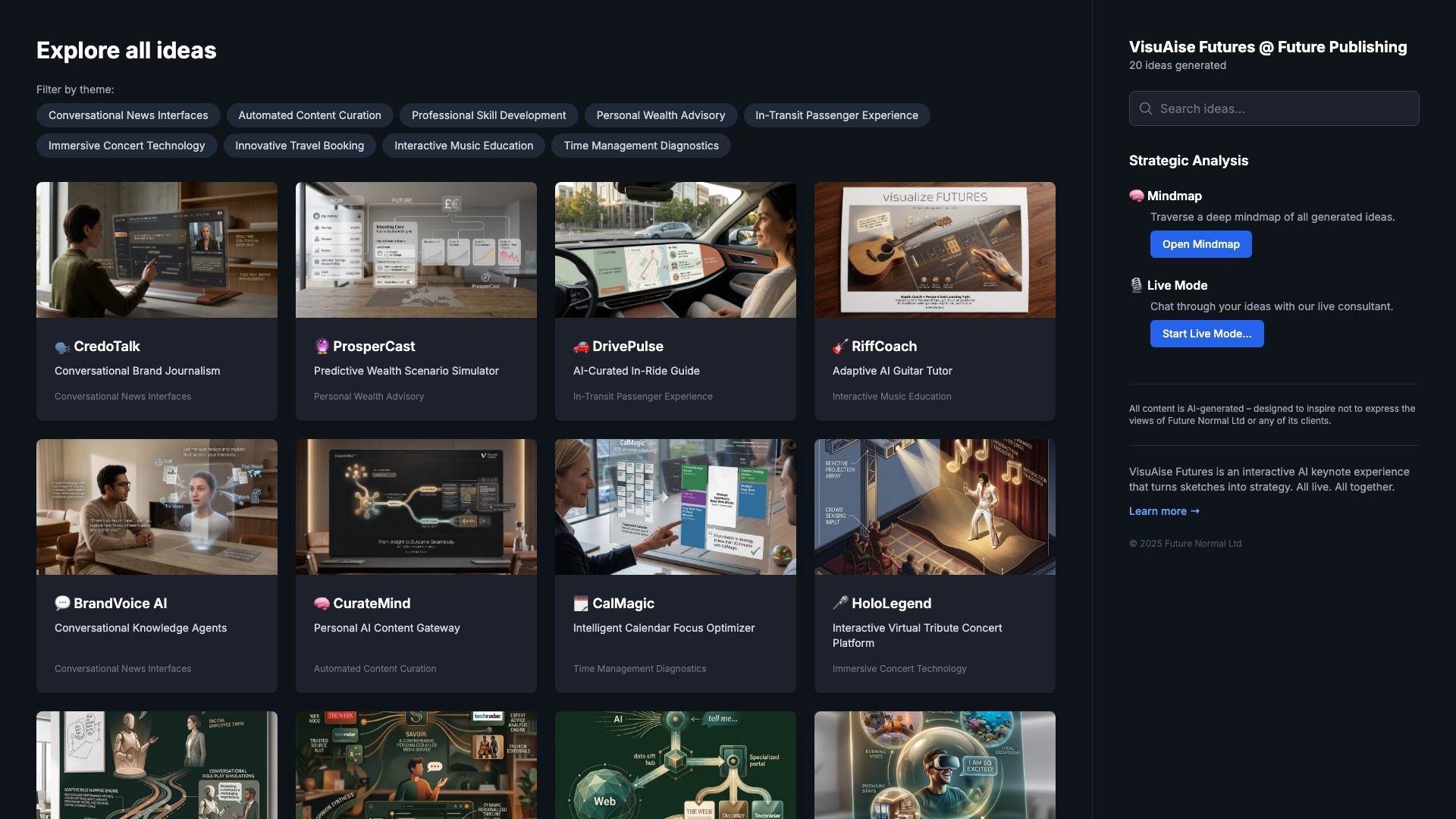
Real, unretouched sketches from the room – tap any one to reveal the AI-generated concept it became.
The joint-biggest cluster – a quarter of the room's unique ideas – contains no articles at all. It listens to your guitar practice, your driving, your working day, and answers "try it like this". The next wave turns the archive into a conversation partner and the feed into a formula readers write themselves. And where content survives, it grows hands: the travel feature that books the holiday it just sold you. The room's verdict on 2030: media stops being something you consume and becomes someone you're with.
Every insight on this page is drawn directly from the audience's own submissions – sketched live, transformed by AI, analysed while the room was still buzzing. Theme percentages are quoted from the published Data & Insight Report.
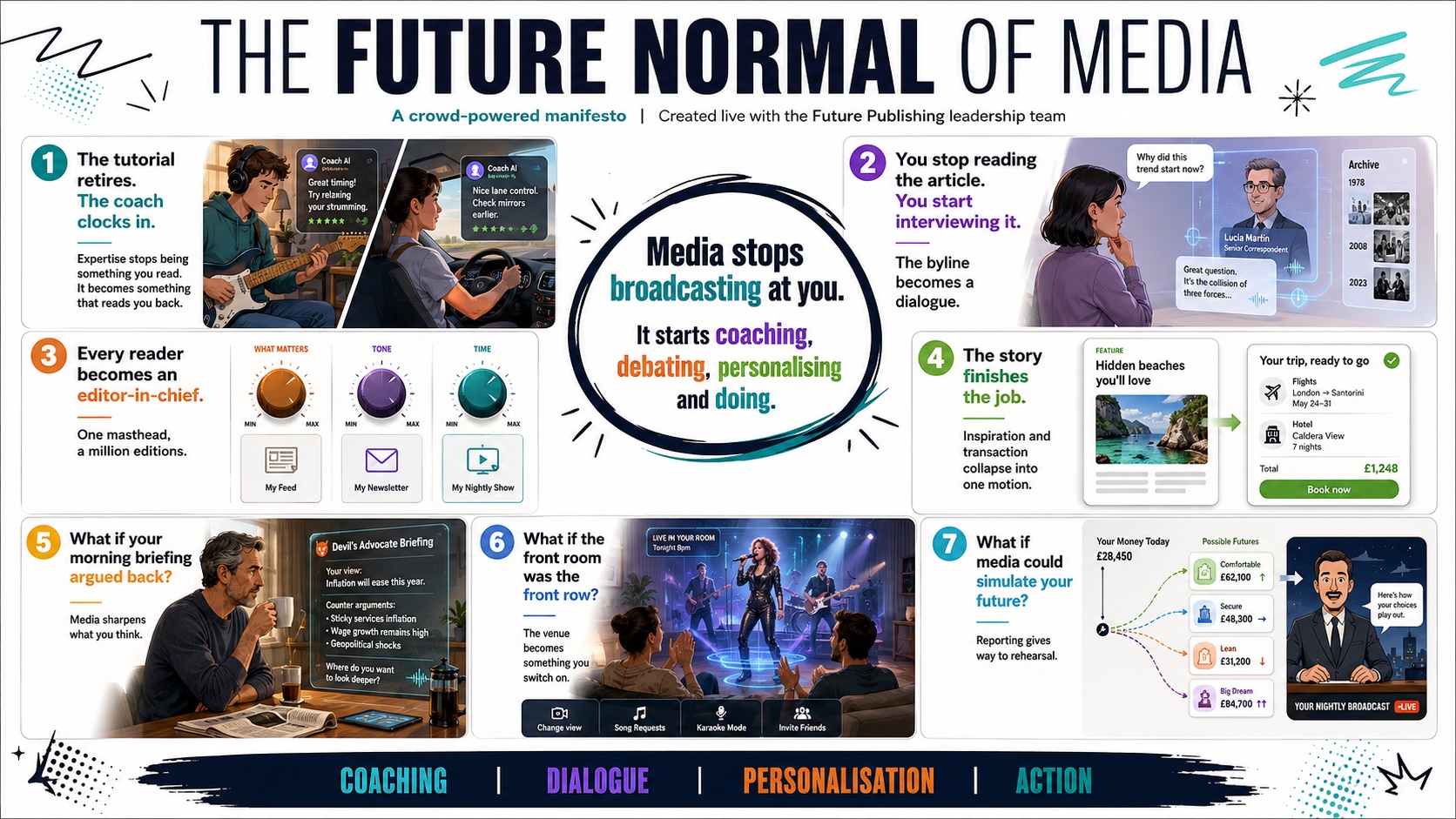
Read together, the sketches stop being individual wishes and start sounding like a shared declaration – a crowd-powered manifesto for the Future Normal of media.
Media stops explaining how and starts watching you try. It listens to your guitar practice and says "try it like this". It sits beside you on your driving lesson. Expertise stops being something you read – it becomes something that reads you back.
From the room: RiffCoach – a practice partner that hears you play · DriveCoach – the car that teaches you to drive · MentorAI & InFlow AI – coaching without leaving the flow of work
Decades of trusted journalism wake up as something you can question. Ask the reporter's verified double, "tell me what that means" – and the brand's entire archive joins the conversation. The byline becomes a dialogue.
From the room: CredoTalk – interact with 'journalists' and the brand · BrandVoice AI – the archive as ambassador · SiftMedia – premium answers, not search results
Stuff you like. What to do with it. How you like it. Readers assemble their own media product from three dials – and the feed, the newsletter and the nightly show rebuild themselves around each person. One masthead, a million editions.
From the room: CurateMind – your custom discovery gateway · Savoir – an advisor with taste, trained on the titles you trust · PersonaCast – a nightly show built for an audience of one
The travel feature books the holiday it just sold you – flights, hotel, budget and all. The hotel room can be stood in before it's paid for. Inspiration and transaction collapse into a single motion. Reading becomes doing.
From the room: ReadToRoam – the article that books the holiday · VoyageSphere – stand in the trip before you buy
Beyond the consensus, the sketches surfaced genuinely novel ideas – the kind no industry roundtable would ever produce.
One leader drew news you can debate: an AI that plays devil's advocate over breakfast, countering your take with evidence before you've finished your coffee. Media's job flips from confirming what you think to sharpening it.
Theme: trust, debate & verificationHolographic karaoke on your carpet. A life-sized band by the sofa. Legends performing for the price of a projector. The venue stops being somewhere you go and becomes something you switch on.
Theme: holograms & immersive entertainmentSnapshot your money today, then toggle tomorrow: the career change, the market dip, the early retirement. Watch each future play out before you commit to one. Money media stops reporting what happened and starts simulating what's next.
Theme: financial foresight toolsOne sketch asked for exactly that: a personalised nightly bulletin anchored by a cartoon icon, built around one man's love of horse-sized-duck debates. Absurd on purpose – and dead serious about what "channel" means when every fan gets their own broadcaster.
Theme: synthetic presenters & personasEvery submission was analysed and clustered live, each idea tagged against every theme it genuinely spans. Here's the distribution – and what each theme signals.
Percentages quoted from the published Data & Insight Report (20 unique ideas from 23 submissions – three near-identical resubmissions merged – each tagged against every theme it genuinely spans). Total coverage exceeds 100% because several ideas span multiple themes, reflecting the integrated, systems-level thinking of participants. One idea – an AI calendar optimiser – left media altogether and sat outside every cluster.
The most strategically valuable signals aren't the consensus – they're the places where 20 ideas pull in opposite directions.
The same room that wants Homer Simpson reading the news and AI doubles of its reporters also built verified source networks and anti-bias tools. When the face of the product is synthetic, trust has to move somewhere else: into the sourcing, the archive, the brand. Whoever engineers that transfer first owns the category.
Four ideas perfect the feed that agrees with you. One – a briefing that plays devil's advocate over breakfast – was built to argue with you. Personalisation's endgame is an echo chamber unless the argument is designed in. The room sensed it, and sketched both sides.
Holographic venues make the front room a place to gather again; drive-time feeds and in-flow coaches dissolve media into the background of other activities. Is the 2030 media brand somewhere you go, or something that travels with you? The room voted both – which means the portfolio has to serve both.
The provocation asked for the future they wished existed – so these absences are invitations, not oversights. They're exactly where the next advantage hides.
In a room full of media leaders: no ads, no subscriptions, no paywalls. The industry's entire revenue machinery went undrawn – while the room happily sketched agents that book holidays and archives that answer questions for free.
What if the monetisation of conversational media is the biggest open question in the building? When the story finishes the job, who invoices? The first publisher to crack the commercial architecture of talk-to-content and read-to-done sets the terms for everyone else.
In a future crowded with synthetic presenters – cartoon anchors, virtual bands, AI brand voices – only one idea grounded its personas in real, verifiable journalists. The people whose judgment makes the brand trustworthy were almost invisible in the room's own sketches.
What if visible human judgment is the premium product of 2030? The publisher that wears its verification on the outside – real reporters, real sources, provenance you can inspect – owns the trust the synthetic feed can't fake.
For the leaders in the room – and the product, editorial and commercial teams who'll carry them.
Take a how-to franchise the audience already trusts and pilot a listening coach – the room's single biggest wish. Measure practice minutes, not page views.
Prototype "interview the article" on one trusted title and watch what readers actually ask. The questions are an editorial calendar no planning meeting could produce.
Build one read-to-booked journey end to end, budget-aware. The commerce model the room drew is the current one with the friction deleted – and the margin kept.
Any synthetic-persona experiment should wear its verification on the outside: real journalists, real sources, visible provenance. The room built the anxiety; build the answer.
Add a challenge-me mode to one briefing product. Against the infinite agreeable feed, judgment – not agreement – is the differentiator a trusted brand can own.
Every idea has its own page – AI concept images, theme tags, and a browsable gallery of everything the room imagined.
Download a single consolidated .md file – all 23 raw submissions (20 unique ideas) with the room's own words and the AI-expanded concepts – and drop it into your LLM of choice, ready to query against your current projects.
The complete Data & Insight Report – theme distribution, the five signals, the tensions, and five moves to turn the doodles into a roadmap.
Henry's full Future Publishing presentation – The Future Normal: Designing a People-First AI Strategy – yours to download and revisit.
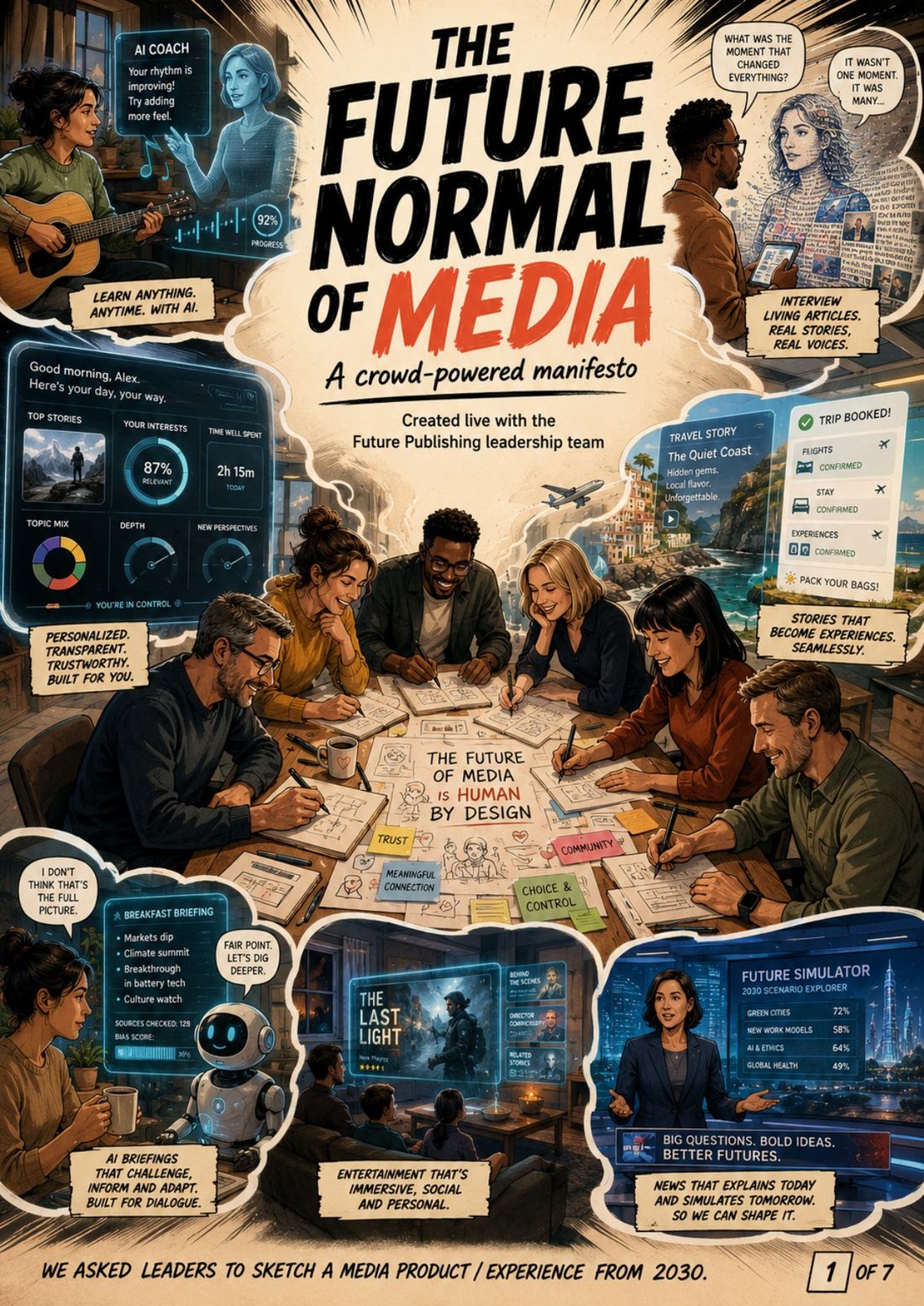
Because a signal report can be a data table – or it can be a seven-page crowd-powered manifesto in graphic-novel form. The room's declarations and what-ifs, panel by panel. Proof that strategic doesn't have to mean dry.

Flip through all seven pages – or download the full manifesto in comic form.
Unfiltered, opt-in feedback captured live in Bath – 18 responses, 100% rated the session positively, and 100% said they'd attend again.
No app. No survey. No consultants. Just pens, paper, a QR code – and an audience doing what no live poll has ever managed: thinking out loud, together.
Everyone sketches their idea. Pen and paper. No artistic skill required.
Scan a QR code, photograph the sketch. No app, no login.
AI turns every sketch into polished concepts – shown live on the big screen.
Themes, tensions and insights emerge from the collective input – in minutes.
You've just experienced the transformational power of AI-native thinking and doing. Strategy engagements used to take months to assemble these insights, but the audience produced the raw material live, mid-keynote – and the analysis you're scrolling was in their hands while the room was still buzzing.
VisuAIse Futures shows 10x thinking in action: the keynote stops being a broadcast and becomes a shared experience. Your audience stops being spectators and becomes your strategy team. And because they co-created every artefact on this page, they want to engage with it afterwards – psychologists call it the IKEA effect; event organisers call it post-event content people finally open.

Every industry has a future its people can already see – they've just never been asked to sketch it. If you're planning a conference keynote, leadership offsite or customer event, let's turn your next audience into your strategy team.
Or just email renee@ideapress-speakers.com